Download
1 / 14
140 likes | 256 Vues
This document provides an in-depth overview of Breadth-First Search (BFS) implemented in Cilk++. It discusses the level-by-level graph traversal approach, along with the serial complexity of Θ(m+n), where m represents the set of edges and n the set of vertices. The analysis includes both parallel and concurrent BFS methodologies with various strategies for managing frontiers. Furthermore, it addresses challenges related to parallelism, including memory constraints and the implications of graph diameter on performance. The contributions of Charles E. Leiserson are acknowledged for the foundational slides.

E N D
CS 240A : Breadth-first search in Cilk++ Thanks to Charles E. Leiserson for some of these slides
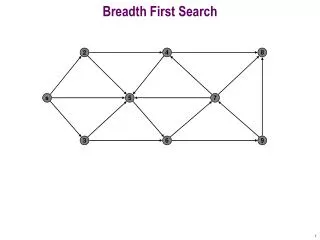
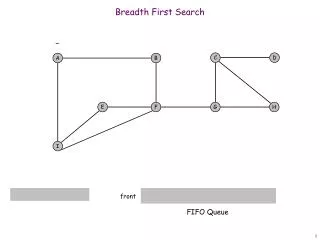
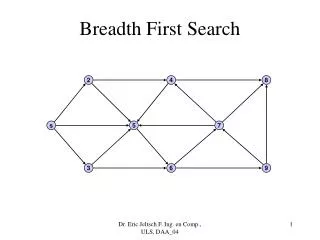
1 2 3 4 5 6 7 8 9 10 11 12 16 17 18 19 Breadth First Search • Level-by-level graph traversal • Serially complexity:Θ(m+n) Graph: G(E,V) E: Set of edges (size m) V: Set of vertices (size n)
1 2 3 4 5 6 7 8 9 10 11 12 16 17 18 19 Breadth First Search • Level-by-level graph traversal • Serially complexity:Θ(m+n) 1 Level 1
1 2 3 4 5 6 7 8 9 10 11 12 16 17 18 19 Breadth First Search • Level-by-level graph traversal • Serially complexity:Θ(m+n) 1 Level 1 5 Level 2 2
1 2 3 4 5 6 7 8 9 10 11 12 16 17 18 19 Breadth First Search • Level-by-level graph traversal • Serially complexity:Θ(m+n) 1 Level 1 5 Level 2 2 6 3 Level 3 9
1 2 3 4 5 6 7 8 9 10 11 12 16 17 18 19 Breadth First Search • Level-by-level graph traversal • Serially complexity:Θ(m+n) 1 Level 1 5 Level 2 2 6 3 Level 3 9 4 16 Level 4 10 7
1 2 3 4 5 6 7 8 9 10 11 12 16 17 18 19 Breadth First Search • Level-by-level graph traversal • Serially complexity:Θ(m+n) 1 Level 1 5 Level 2 2 6 3 Level 3 9 4 4 16 16 Level 4 10 7 11 8 Level 5 17
1 2 3 4 5 6 7 8 9 10 11 12 16 17 18 19 Breadth First Search • Level-by-level graph traversal • Serially complexity:Θ(m+n) 1 Level 1 5 Level 2 2 6 3 Level 3 9 4 4 16 16 Level 4 10 7 11 8 Level 5 17 18 Level 6 12
1 2 3 4 5 6 7 8 9 10 11 12 16 17 18 19 Breadth First Search • Who is parent(19)? • If we use a queue for expanding the frontier? • Does it actually matter? 1 Level 1 5 Level 2 2 6 3 Level 3 9 4 4 16 16 Level 4 10 7 11 8 Level 5 17 18 Level 6 12
Parallel BFS Bag<T> has an associative reduce function that merges two sets • Way #1: A custom reducer void BFS(Graph *G, Vertex root) { Bag<Vertex> frontier(root); while ( ! frontier.isEmpty() ) { cilk::hyperobject< Bag<Vertex> > succbag(); cilk_for (int i=0; i< frontier.size(); i++) { for( Vertex v in frontier[i].adjacency() ) { if( ! v.unvisited() ) succbag() += v; } } frontier = succbag.getValue(); } } operator+=(Vertex & rhs) also marks rhs “visited”
Parallel BFS • Way #2: Concurrent writes + List reducer void BFS(Graph *G, Vertex root) { list<Vertex> frontier(root); Vertex * parent = new Vertex[n]; while ( ! frontier.isEmpty() ) { cilk_for (int i=0; i< frontier.size(); i++) { for( Vertex v in frontier[i].adjacency() ) { if ( ! v.visited() ) parent[v] = frontier[i]; } } ... } } An intentional data race How to generate the new frontier?
Parallel BFS Run cilk_for loop again void BFS(Graph *G, Vertex root) { ... while ( ! frontier.isEmpty() ) { ... hyperobject< reducer_list_append<Vertex> > succlist(); cilk_for (int i=0; i< frontier.size(); i++) { for( Vertex v in frontier[i].adjacency() ) { if ( parent[v] == frontier[i] ) { succlist.push_back(v); v.visit(); // Mark “visited” } } } frontier = succlist.getValue(); } } !v.visited() check is not necessary. Why?
Work: T1(n) = Θ(m+n) Span: T∞(n) = Θ(d) Parallelism: T1(n) = Θ((m+n)/d) T∞(n) Parallel BFS • Each level is explored with Θ(1) span • Graph G has at most d, at least d/2 levels • Depending on the location of root • d=diameter(G)
Parallel BFS Caveats • d is usually small • d = lg(n) for scale-free graphs • But the degrees are not bounded • Parallel scaling will be memory-bound • Lots of burdened parallelism, • Loops are skinny • Especially to the root and leaves of BFS-tree • You are not “expected” to parallelize BFS part of Homework #4 • You may do it for extra credit though