Flexibility Training: Enhancing Joint Mobility and Stability
Learn about the importance of flexibility training, benefits, factors affecting flexibility, and different types of stretching techniques. Gain insights into how to optimize joint mobility while maintaining stability through safe and effective practices.


Flexibility Training: Enhancing Joint Mobility and Stability
E N D
Presentation Transcript
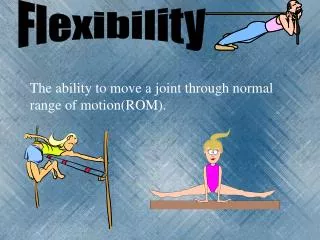
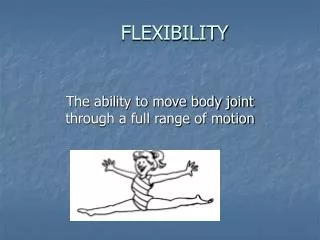
Flexibility • Flexibility refers to the total range of motion (ROM) of a joint or group of joints. • The ability of a joint to move freely through the full range of motion. • It differs from person to person and from joint to joint. • What affects the extent of movement around a given joint? • Structural characteristics of the joint • Mechanical properties of the connective tissues
Flexibility • The GOAL should be to optimize joint mobility while maintaining joint stability. • Primary FOCUS should be on the systematic, safe and effective application of the range of motion techniques used. • You should be able to communicate to the client WHY they should devote time to improving flexibility • It will enhance their program.
Flexibility • Keep the requirements of the activity in mind • A person’s activity level alone will not improve flexibility • Stretching exercises are essential if flexibility is to be maintained or increased
Benefits of Flexibility Training • Increases Range of Motion • Reduction of lower back pain and injury • Reduction in the incidence & severity of injuries • Improved posture & muscle symmetry • Delay in the onset of muscular fatigue • Prevents or alleviates muscle soreness post exercise • Increases the level of certain skills & muscular efficiency • Picking something up off the floor • Promotes mental relaxation
Flexibility • It must be based upon the needs of the client. • Deliberate stretching should be done AFTER a general warm-up, but BEFORE the primary bout BUT…. • It is dependant upon the activity to be performed. • Stair climbing vs. Basketball
General Warm Up • Full body rhythmic activities • Low-moderate intensities • ~ 5 minutes • Increase core temp • Should not lead to fatigue
Specific Warm Up • Specific warm up for the activity • ~ 10 minutes
Factors Affecting Flexibility • Joint Structure • Age • Gender • Muscle & Connective Tissue • Exercise History • Temperature • Resistance Training • Pregnancy
Joint Structure • Joint Structure • Some joints allow more range than others
Age & Gender • Young more flexible than older • Females more flexible than men • Youth become less flexible between ages 10-12 • Childhood is the ideal time to start a flexibility program • Seniors lose flexibility due to inactivity
Muscle & Connective Tissue • Tendons, ligaments, fascia, joint capsules, skin • Elasticity – the ability to return to original resting length after passive stretch • Plasticity – the tendency to assume a new and greater length after passive stretch • Hyperlaxity – allows the joints to achieve a ROM that exceeds the normal range of motion
F.I.T. of Stretching • 2 times per week, for 5 weeks, has been shown to improve flexibility • Varies depending upon the sport / activity • General warm up for ~ 5 minutes • Activity specific warm up ~ 10 minutes • Post activity stretching ~ 5 minutes • Hold each stretch for about 30 seconds • Do 4 reps
Proprioceptors & Stretching • Muscle Spindles • Within muscle • Causes stretch reflex • Muscle contracts when stretch too fast • Golgi Tendon Organs • MT Junction • Produces inverse stretch reflex • Relaxes muscle when there is too much tension
Types of Stretching • Static – slow & steady • Ballistic - bouncing type movements • Dynamic– avoids bouncing but includes movements specific to the activity • PNF – generally involves a 10 s passive stretch followed by the specific technique: • Hold-Relax • Contract-Relax
Static Stretching • Most commonly used • Safe & effective • Muscle gradually stretched to the point of mild tension • If discomfort is felt, back off a little • Does not activate the stretch reflex • Beginners should hold the stretch for 15-20 s; progress to 30 s • Longer holds do not reap more rewards • Significant improvements can occur • Repeat 3-5 times
Ballistic Stretching • Rapid, jerky, uncontrolled movement • Difficult to control the motion • Higher risk of injury • No longer considered acceptable however, is appropriate for some activities • Disadvantages: • Increased danger of exceeding the extensibility limits of involved tissues • Higher energy requirements • Greater chance of causing muscle soreness • Activation of the stretch reflex
Dynamic Stretching • Similar to ballistic but avoids bouncing • Puts an emphasis on functionally based movements • Includes movements specific to the activity • Example lunge walk • Requires balance and coordination • Clients may experience muscle soreness initially
PNF Stretching • Widely accepted as an effective method for increasing range of motion • Performed with a partner • Uses both passive movement & active muscle action • Technique: • Take the muscle into a static stretch while relaxing muscle • Hold stretch for 10 s, then contract muscle for 6 s with a strong isometric contraction against partner • Following a 1-2 s rest, repeat another 30 s passive stretch • Repeat
Summary • Assess client’s flexibility to pinpoint strengths & weakness • Design program that stretches the specific muscles used by the client during activity • Warm up before stretching to increase temp • Perform stretches daily • Stretch all major muscle groups and opposing groups
Summary • Focus on technique during the stretch • Hold stretches for 15-20 seconds initially; later 30 seconds • Do 4 reps each stretch for optimal gains • Stretch to mild discomfort, not pain • Keep breathing slow and rhythmical during stretch • Stretch muscles in different positions and planes • Stretch after primary bout
Neck Shoulders & Chest Torso Upper Back Lower Back Hips Posterior Arm Anterior Thigh & Hip Flexor Posterior Thigh Adductors “Groin” Calf Stretching Body Regions