Percentages
This brief review explains the meanings of "per" and "cent," illustrating how percentages work in everyday contexts like pricing and speed. It breaks down the concept of "per cent" as "per one hundred," described with the symbol %. The guide covers essential conversions, showing how to translate percentages into common fractions and decimals. Readers will learn to simplify fractions, convert fractions to percentages, and vice versa, ensuring a clear understanding of these mathematical relationships in practical terms.

Percentages
E N D
Presentation Transcript
Percentages or Fractions Disguised by a Latin Name epw 10/9/06
A short review… epw 10/9/06
Per Something • “per something” means • “divided by something” • Such as $3.25 per gallon, or • $.99 per pound, or • 25 miles per hour, or • 8¢per kilowatt-hour, and can be expressed as epw 10/9/06
Latin per cent • per cent means “per one hundred” • which is “divided by 100” • We use the symbol % as a shorthand for the words per cent • We read 50% as “50 percent” and it means epw 10/9/06
The Big P • For a number P epw 10/9/06
Examples epw 10/9/06
Examples (cont.) = 15 epw 10/9/06
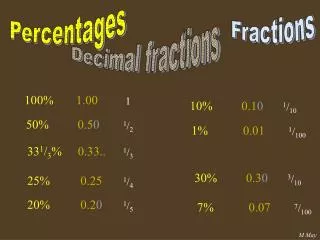
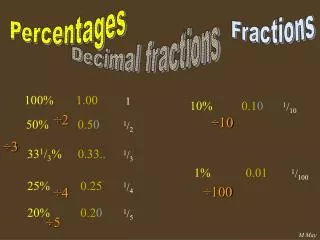
Conversions(those pesky conversions, again! ) • Percentage to a common fraction • Replace % symbol with division by 100 • Simplify the fraction if necessary epw 10/9/06
Conversions (cont.) • Convert a percentage to a decimal • Drop the % symbol and move the decimal point two places to the left epw 10/9/06
Conversions (cont.) • Convert a decimal to a percentage • Move the decimal point two places to the right (adding a zero if necessary), and • Add the % symbol 0.43 = 43% 0.7 = 70% 0.0043 = 0.43% epw 10/9/06
Conversions (cont.) • Convert a common fraction to a percentage • Convert the fraction to decimal form, then • Convert the decimal to a percentage epw 10/9/06
The End! epw 10/9/06