Prolog Logic Pursuits
Explore Prolog concepts through logical exercises and examples, covering topics like relationships, pruning, and arithmetic expressions. Learn how to solve queries and navigate through complex structures effectively.

Prolog Logic Pursuits
E N D
Presentation Transcript
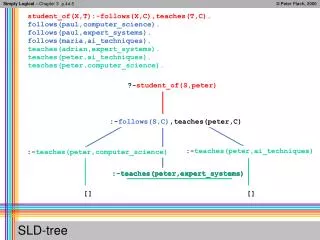
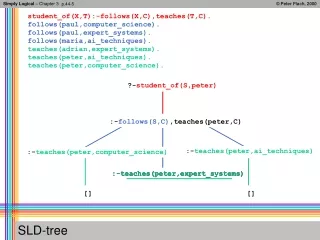
Simply Logical – Chapter 3 :-follows(S,C),teaches(peter,C) :-teaches(peter,ai_techniques) :-teaches(peter,computer_science) :-teaches(peter,expert_systems) p.44-5 [] [] student_of(X,T):-follows(X,C),teaches(T,C).follows(paul,computer_science).follows(paul,expert_systems).follows(maria,ai_techniques).teaches(adrian,expert_systems).teaches(peter,ai_techniques).teaches(peter,computer_science). ?-student_of(S,peter) ?-student_of(S,peter) :-follows(S,C),teaches(peter,C) :-teaches(peter,ai_techniques) :-teaches(peter,computer_science) :-teaches(peter,expert_systems) SLD-tree
Simply Logical – Chapter 3 :-brother_of(B,peter) [] :-brother_of(peter,B) :-brother_of(B,peter) • [] • • :-brother_of(paul,Z),brother_of(Z,B) [] :-brother_of(peter,B) :-brother_of(paul,Z1),brother_of(Z1,Z),brother_of(Z,B) • • • :-brother_of(peter,Z),brother_of(Z,B) [] • • • p.45-6 ?-brother_of(peter,B) brother_of(X,Y):-brother_of(Y,X).brother_of(paul,peter). ?-brother_of(paul,B) brother_of(paul,peter).brother_of(peter,adrian).brother_of(X,Y):- brother_of(X,Z), brother_of(Z,Y). Infinite SLD-trees
Simply Logical – Chapter 3 :-list(T1) [] L = [] :-list(T2) [] L = [A] :-list(T3) [] • L = [A,B] • • p.47 list([]). list([H|T]):-list(T). ?-list(L).L = [];L = [A];L = [A,B];… ?-list(L) Exercise 3.2
Simply Logical – Chapter 3 :-p(H1),plist(T1) [] L = [] :-plist(T1) :-plist(T1) :-plist(T1) :-plist(T1) :-plist(T1) :-plist(T1) :-p(H1),plist(T1) :-p(H1),plist(T1) [] [] [] [] [] [] L = [2] L = [1,2] L = [2,1] L = [1,1] L = [2,2] L = [1] • • • • • • • • • • • • p.47 plist([]). plist([H|T]):- p(H),plist(T). p(1). p(2). ?-plist(L) ?-plist(L).L=[];L=[1];L=[1,1];… Depth-first search
Simply Logical – Chapter 3 :-father(john,C) :-mother(john,C) [] :-father(john,C),! :-mother(john,C) :-! p.48-9 [] ?-parent(john,C) parent(X,Y):-father(X,Y).parent(X,Y):-mother(X,Y).father(john,paul).mother(mary,paul). ?-parent(john,C) parent(X,Y):-father(X,Y),!.parent(X,Y):-mother(X,Y).father(john,paul).mother(mary,paul). Pruning by means of cut
Simply Logical – Chapter 3 :-q(X,Y) :-r(X,Y) :-s(X),!,t(Y) [] :-!,t(Y) :-!,t(Y) :-t(Y) :-t(Y) p.50 [] [] [] [] ?-p(X,Y) p(X,Y):-q(X,Y). p(X,Y):-r(X,Y). q(X,Y):-s(X),!,t(Y). r(c,d). s(a). s(b). t(a). t(b). The effect of cut
Simply Logical – Chapter 3 :-father(P,paul),! :-mother(P,paul) :-! [] [] :-father(john,C),! :-mother(john,C) :-! :-! p.50-1 [] [] ?-parent(P,paul) parent(X,Y):-father(X,Y),!.parent(X,Y):-mother(X,Y).father(john,paul).mother(mary,paul). ?-parent(john,C) parent(X,Y):-father(X,Y),!.parent(X,Y):-mother(X,Y).father(john,paul).father(john,peter).mother(mary,paul).mother(mary,peter). Pruning away success branches
Simply Logical – Chapter 3 :-friendly(B) :-student_of(B,A) [] [] [] A=peterB=maria A=peterB=maria A=peterB=paul :-!,friendly(B) :-student_of(B,A) :-student_of(B,A),! :-friendly(B) :-! :-! :-friendly(B) [] [] [] A=peterB=maria A=peterB=paul A=peterB=maria p.52 [] [] [] A=peterB=maria A=peterB=paul A=peterB=maria ?-likes(A,B) likes(peter,Y):-friendly(Y).likes(T,S):-student_of(S,T).student_of(maria,peter).student_of(paul,peter).friendly(maria). likes(peter,Y):-!,friendly(Y). likes(T,S):-student_of(S,T),!. ?-likes(A,B) ?-likes(A,B) Exercise 3.3
Simply Logical – Chapter 3 :-q,r :-not(q),s :-q,!,fail,s :-s [] :-q,!,r :-s p.54 [] ?-p p:-q,r.p:-not(q),s.s. not(Goal):-Goal,!,fail.not(Goal). ?-p p:-q,!,r.p:-s.s. not vs. cut
Simply Logical – Chapter 3 :-q :-not(q),r :-q,!,fail,r :-r [] :-!,fail,r [] :-fail,r p.55 ?-p p:-not(q),r.p:-q.q.r. not(Goal):-Goal,!,fail.not(Goal). :-not(q) fails
Simply Logical – Chapter 3 :-not(married(X)),man(X) :-man(X) :-married(X),!,fail,man(X) [] [] :-!,fail,man(fred) :-fail,man(fred) :-man(X),not(married(X)) :-not(married(peter)) :-not(married(fred)) [] [] :-married(peter),!,fail :-married(fred),!,fail :-!,fail p.56-7 :-fail ?-bachelor(X) bachelor(X):-not(married(X)),man(X).man(fred).man(peter).married(fred). ?-bachelor(X) bachelor(X):-man(X),not(married(X)). Prolog’s not is unsound
Simply Logical – Chapter 3 :-q,r,if_s_then_t_else_u :-q,r,u :-q,r,s,!,t :-r,if_s_then_t_else_u :-r,u :-r,s,!,t :if_s_then_t_else_u :-u :-s,!,t :-u :-s,!,t p.58 [] [] p:-q,r,s,!,t.p:-q,r,u.q.r.u. p:-q,r,if_s_then_t_else_u.if_s_then_t_else_u:-s,!,t.if_s_then_t_else_u:-u.q.r.u. ?-p ?-p Exercises 3.7-8
Simply Logical – Chapter 3 ?-display(5+7-3). -(+(5,7),3) - p.60-2 + 3 5 7 ?-X is 5+7-3.X = 9 ?-9 is 5+7-3.Yes ?-X is 5*3+7/2.X = 18.5 ?-9 is X+7-3.Error in arithmetic expression ?-9 = 5+7-3.No ?-X = 5+7-3.X = 5+7-3 ?-9 = X+7-3.No ?-X = Y+7-3.X = _947+7-3Y = _947 Prolog arithmetic vs.unification
Simply Logical – Chapter 3 p.62 • zero(A,B,C,X):-X is (-B + sqrt(B*B - 4*A*C)) / 2*A. • zero(A,B,C,X):-X is (-B - sqrt(B*B - 4*A*C)) / 2*A. Exercise 3.9
Simply Logical – Chapter 3 p.62 • Prolog does not check for circular bindings • ?-X = f(X).X = f(f(f(f(f(f(f(f(f(f(f(f(f(f(f(f(f(f(f(f(Error: term being written is too deep • This may lead to unsound behaviour • strange:-X=f(X). • ?-strange.Yes Occur check
Simply Logical – Chapter 3 {H->a, T->[b,c], N1->N} :-length([b,c],M1), N is M1+1 {H->b, T->[c], N2->M1} :-length([c],M2), M1 is M2+1, N is M1+1 {H->c, T->[], N3->M2} :-length([],M3), M2 is M3+1, M1 is M2+1, N is M1+1 {M3->0} :-M2 is 0+1, M1 is M2+1, N is M1+1 {M2->1} :-M1 is 1+1, N is M1+1 {M1->2} p.63 :-N is 2+1 {N->3} [] length([H|T],N1):-length(T,M1), N1 is M1+1 ?-length([a,b,c],N) length([H|T],N2):-length(T,M2), N2 is M2+1 length([H|T],N3):-length(T,M3), N3 is M3+1 length([],0) length([],0). length([H|T],N):-length(T,M),N is M+1. Exercise 3.10
Simply Logical – Chapter 3 {H->a, T->[b,c], N10->0, N1->N} :-N11 is 0+1, length_acc([b,c],N11,N) {N11->1} :-length_acc([b,c],1,N) {H->b, T->[c], N20->1, N2->N} :-N21 is 1+1, length_acc([c],N21,N) {N21->2} :-length_acc([c],2,N) {H->c, T->[], N30->2, N3->N} :-N31 is 2+1, length_acc([],N31,N) {N31->3} :-length_acc([],3,N) p.63 {N->3} [] length_acc([H|T],N10,N1):-N11 is N10+1, length_acc(T,N11,N1) ?-length_acc([a,b,c],0,N) length_acc([H|T],N20,N2):-N21 is N20+1, length_acc(T,N21,N2) length_acc([H|T],N30,N3):-N31 is N30+1, length_acc(T,N31,N3) length_acc([],N,N). length_acc([H|T],N0,N):-N1 is N0+1,length_acc(T,N1,N). length_acc([],N,N) Exercise 3.11
Simply Logical – Chapter 3 XPlus XMinus YPlus YMinus XPlus p.65 YMinus append_dl(XPlus-XMinus,YPlus-YMinus,XPlus-YMinus):-XMinus=YPlus. ?-append_dl([a,b|X]-X,[c,d|Y]-Y,Z).X = [c,d|Y], Z = [a,b,c,d|Y]-Y Difference lists
Simply Logical – Chapter 3 p.67-8 ?-findall(C,parent(john,C),L). L = [peter,paul,mary] ?-findall(C,parent(P,C),L). L = [peter,paul,mary,davy,dee,dozy] parent(john,peter). parent(john,paul). parent(john,mary). parent(mick,davy). parent(mick,dee). parent(mick,dozy). ?-bagof(C,parent(P,C),L). P =john L = [peter,paul,mary]; P =mick L = [davy,dee,dozy] ?-bagof(C,P^parent(P,C),L). L = [peter,paul,mary,davy,dee,dozy] Second-order predicates
Simply Logical – Chapter 3 p.70-2 prove(true):-!. prove((A,B)):-!,prove(A),prove(B). prove(A):-/* not A=true, not A=(X,Y) */clause(A,B),prove(B). prove_r(true):-!. prove_r((A,B)):-!,clause(A,C),conj_append(C,B,D),prove_r(D). prove_r(A):-/* not A=true, not A=(X,Y) */clause(A,B),prove_r(B). Prolog meta-interpreters
Simply Logical – Chapter 3 REASONING KNOWLEDGE META- clause(p(X),q(X)). ?-prove(p(X)). clause(q(a),true). X=a LEVEL unification OBJECT- p(X):-q(X). ?-p(X). LEVEL q(a). X=a p.71 Meta-level vs. object-level
Simply Logical – Chapter 3 p.74-6 • Write down declarative specification • % partition(L,N,Littles,Bigs) <- Littles contains numbers • % in L smaller than N, • % Bigs contains the rest • Identify recursion and ‘output’ arguments • Write down skeleton • partition([],N,[],[]). • partition([Head|Tail],N,?Littles,?Bigs):-/* do something with Head */partition(Tail,N,Littles,Bigs). Logic programming methodology
Simply Logical – Chapter 3 p.74-6 • Complete bodies • partition([],N,[],[]). • partition([Head|Tail],N,?Littles,?Bigs):-Head < N,partition(Tail,N,Littles,Bigs),?Littles = [Head|Littles],?Bigs = Bigs. • partition([Head|Tail],N,?Littles,?Bigs):-Head >= N,partition(Tail,N,Littles,Bigs),?Littles = Littles,?Bigs = [Head|Bigs]. • Fill in ‘output’ arguments • partition([],N,[],[]). • partition([Head|Tail],N,[Head|Littles],Bigs):-Head < N,partition(Tail,N,Littles,Bigs). • partition([Head|Tail],N,Littles,[Head|Bigs]):-Head >= N,partition(Tail,N,Littles,Bigs). Methodology
Simply Logical – Chapter 3 p.76 • Write down declarative specification • % sort(L,S) <- S is a sorted permutation of list L • Write down skeleton • sort([],[]). • sort([Head|Tail],?Sorted):-/* do something with Head */sort(Tail,Sorted). • Complete body (auxiliary predicate needed) • sort([],[]). • sort([Head|Tail],WholeSorted):-sort(Tail,Sorted),insert(Head,Sorted,WholeSorted). Writing a sort predicate
Simply Logical – Chapter 3 p.77 • Write down declarative specification • % insert(X,In,Out) <- In is a sorted list, Out is In • % with X inserted in the proper place • Write down skeleton • insert(X,[],?Inserted). • insert(X,[Head|Tail],?Inserted):-/* do something with Head */insert(X,Tail,Inserted). Writing an insert predicate
Simply Logical – Chapter 3 p.77 • Complete bodies • insert(X,[],?Inserted):-?Inserted=[X]. • insert(X,[Head|Tail],?Inserted):-X > Head,insert(X,Tail,Inserted),?Inserted = [Head|Inserted]. • insert(X,[Head|Tail],?Inserted):-X =< Head,?Inserted = [X,Head|Tail]. • Fill in ‘output’ arguments • insert(X,[],[X]). • insert(X,[Head|Tail],[X,Head|Tail]):-X =< Head. • insert(X,[Head|Tail],[Head|Inserted]):-X > Head,insert(X,Tail,Inserted). Writing an insert predicate