Exploring Proportions and Similarity in Polygons
This resource focuses on understanding proportions through practical problems involving angles and side ratios. It covers a pentagon's angles in a 3:3:4:3:5 ratio, guiding you on how to find each angle's measure. Additionally, it examines a rectangle with a 3:4 side ratio and an area of 150, helping you calculate the lengths of its sides. The document also delves into similar polygons, discussing congruent angles, similarity ratios, and the use of proportions to find missing dimensions, ensuring a comprehensive grasp of these geometric concepts.

Exploring Proportions and Similarity in Polygons
E N D
Presentation Transcript
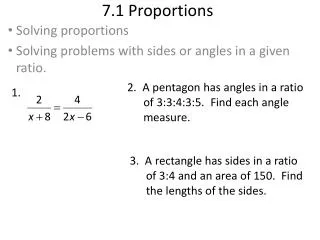
7.1 Proportions 2. A pentagon has angles in a ratio of 3:3:4:3:5. Find each angle measure. 1. Solving proportions Solving problems with sides or angles in a given ratio. 3. A rectangle has sides in a ratio of 3:4 and an area of 150. Find the lengths of the sides.
7.2: Similar Polygons Corresponding angles are congruent. • Determine if two polygons are similar: • Write the similarity ratio. • Write a similarity statement. • Use proportions to find missing dimensions. Corresponding sides are proportional. Ratio of corresponding sides in simplest form. Quadrilateral ABCD ~ Quadrilateral DEFG. Remember corresponding parts must match and vertices must go around the figure..
C S R B x-2 4 6 8 T 12 D 9 10 Q A y+3
7.4 Triangle Proportionality Theorems If then a a c c > > d d b b > > If then If then > c a > b d >
7.5: Proportional Relationships • Indirect measurements • Relationships between similarity ratio, ratio of perimeters and ratios of areas. 10 8 P=48 A=102