Islam After the Prophet
This overview traces the history of Islamic governance from the Rashidun Caliphate, initiated after the Prophet Muhammad's death, through the Umayyads and Abbasids, to the powerful empires of the Ottomans and Safavids. Key events such as Ali's assassination, the expansion policies of each caliphate, and significant cultural developments reveal the complexities of Islamic society. The narrative emphasizes the relationship between political power and religious sects, as seen in the Sunni-Shia divide, and reflects on modern Islamic practices and beliefs.
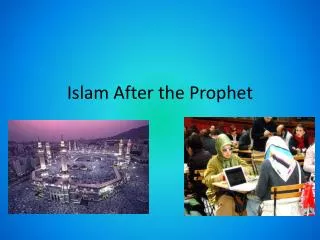

Islam After the Prophet
E N D
Presentation Transcript
Review • Position of caliph created • Economic, social, and political power. • The Rashidun Caliphate expands the territories of Islam • The assassination of Ali leads to the creation of the modern sects of Islam
The Umayyad Caliphate • The Umayyads take power in 661 ACE. Capital moved to Damascus in present day Syria. Expansion is a primary focus for the Umayyad caliphate
The Umayyad Caliphate • As the numbers of converts to Islam grew, classes developed => dissension • Arab conquerors • Non-Arab converts • Those that did not convert (dhimmis) • Tired of being second class citizens, new converts and the Shia join the Abassids and overthrow the Umayyad Caliphate.
The Abbasids • The Abbasids took power in 750 ACE. • Founder: As-Saffah • Golden age for learning and science • Shift the capital to Baghdad Umayyad leaders retained control of Spain until the Spanish Reconquista!
The Abbasids • Began converting Turkic PNBs in the Northwest: The Seljuks! • Battle of Manzikert 1071 ACE => Turks defeat Byzantines Alp Arslan
Sufis • Considered mystics, this group aims at living a simple life devoted to Allah. • They choose to live poor, which they believe makes them more in touch with the sufferings of early converts to Islam.
The Ottomans • Founded in 1299 by Osman I • Practiced religious tolerance, but predominantly Sunni. • Gunpowder Empire • Very powerful internationally
The Ottomans The height of the Ottoman Empire (16th-17th centuries)
The Safavids • Founded in Iran by Shah Ismail in 1501 • Persian culture revival • Shia dynasty => clashed with the Ottomans • Gunpowder Empire
The Safavids • Very powerful and well respected internationally
Modern Islam • Dress– Not all Muslims cover themselves with a veil. This is a traditional Persian practice. • Five Pillars • Food– Eating pork is haraam (forbidden) • Festivals Dave Chappelle– Aside from being Rick James, he also practices Islam