Cognitive Development in Early Childhood: Understanding the First Two Years
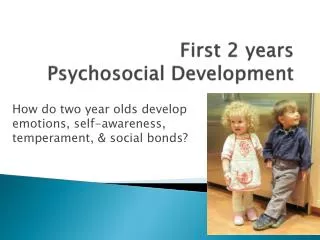
This overview explores the cognitive development stages during the first two years of life, focusing on the sensorimotor intelligence that infants develop through sensory experiences. Topics include primary and secondary circular reactions, the concept of object permanence, and the phases of interaction from reflexive responses to goal-directed behavior. It also discusses memory types, language acquisition theories, and how babies learn to communicate through cooing, babbling, and using holophrases, offering insights into infant cognitive processing and early language skills.

Cognitive Development in Early Childhood: Understanding the First Two Years
E N D
Presentation Transcript
Sensorimotor Intelligence • Learned through the senses • Circular reaction • Sensation – perception – cognition cycle around and around
Primary circular reaction • Stage 1 ( Reflexes) • Birth – 1yr. • Responding to own body • Grasping • Sucking • Stepping • Stage 2 (Habits) • 1 – 4 Months • Adapting reflexes to new situations • (Acquired adaptation) • E.g. Sucking from mom’s nipple to bottle to pacifier • A sign baby is thinking
Secondary circular reaction • Responding to other people & objects • Stage 3 (Continuing interaction) • 4 – 8 months • Making interesting sights last • Stage 4 ( Starting interaction) • 8 mos. – 1yr. • Infant has goals • Initiates and anticipates • Initiates • E.g. Patty-cake • Anticipates • E.g. Running from an unwanted bath • Object permanence
Tertiary circular reaction • Stage 5 (Acts independently - Experimenting) • 1 yr. - 18 mos. • Active experimenting • “Little scientist” • Stage 6 (Thought before action) • 18 mos. – 2yrs. • Thinks about consequences • Deferred imitation
Affordance ( opportunities) • Opportunities to interact with people and things • Visual Cliff • Based on experience • 6 month will go over cliff • 10 Month will refuse
Perception • Movement • Dynamic Perception • People preference • Preference for looking at faces
Memory • Implicit • Hidden • Unconscious habits, emotions procedures • Early language, smells, places • Explicit • Stored in the hippocampus • Usually verbal • Recalled on demand • Words, data, concepts • Reminders help
Universal sequence • Reflexes, cooing, babbling, spoken words • All babies, regardless of native language follow this sequence • Listening & Responding • Babbling • E.g. ma-ma-ma, da-da-da • Holophrase • One word = phrase • E.g. Cookie, Dada! • Naming explosion • 1 yr. to 18 months • Nouns • Ma-ma, da-da, na-na • Elimination • Pee-pee, wee-wee, poo-poo
Theories of Language • 1. Learning theory • 2. Social Pragmatic • 3. Innate • 4. Hybrid
1. Learning theory • Based on B.F. Skinner • Reinforcement • E.g. Parents talking to children • Children learn what they hear
2. Social Pragmatic • Needed for communication • Parents • Outside world
3. Innate • Norm Chomsky • Children have an inborn ability to learn language • E.g. Grammar • Hypothesized a Language Acquisition Device (LAD) in the brain. • Enables universal inborn ability to learn language • Language in general is experience-expectant • Words are expected by the developing brain • Specific language is experience-dependent
4. Hybrid • Combination of the other three • Multiple cues contribute to learning language