
Screening and Analysis of OIF/OEF Veterans with Mild Traumatic Brain Injury and PTSD
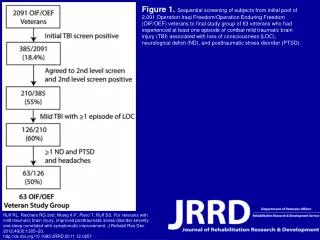
This study investigates the sequential screening process of 2,091 Operation Iraqi Freedom/Operation Enduring Freedom veterans, ultimately narrowing down to 63 participants who experienced at least one episode of combat-related mild traumatic brain injury (TBI) with symptoms such as loss of consciousness, neurological deficits, and posttraumatic stress disorder (PTSD). Findings indicate that improved severity of PTSD and sleep quality correlated with symptomatic improvement in these veterans, underscoring the importance of targeted interventions.

Screening and Analysis of OIF/OEF Veterans with Mild Traumatic Brain Injury and PTSD
E N D
Presentation Transcript
Figure 1. Sequential screening of subjects from initial pool of 2,091 Operation Iraqi Freedom/Operation Enduring Freedom (OIF/OEF) veterans to final study group of 63 veterans who had experienced at least one episode of combat mild traumatic brain injury (TBI) associated with loss of consciousness (LOC), neurological deficit (ND), and posttraumatic stress disorder (PTSD). Ruff RL, Riechers RG 2nd, Wang X-F, Piero T, Ruff SS. For veterans with mild traumatic brain injury, improved posttraumatic stress disorder severity and sleep correlated with symptomatic improvement. J Rehabil Res Dev. 2012;49(9):1305–20.http://dx.doi.org/10.1682/JRRD.2011.12.0251
