
IceCube String Calibration: Objectives and Methodology
E N D
Presentation Transcript
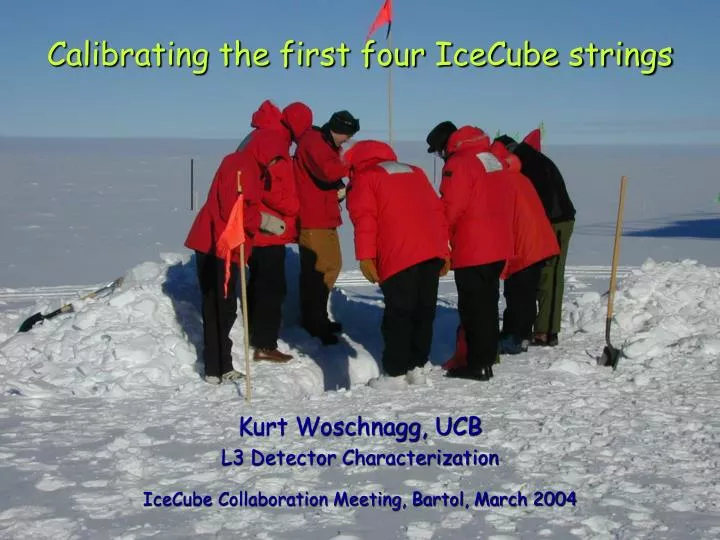
Calibrating the first four IceCube strings Kurt Woschnagg, UCB L3 Detector Characterization IceCube Collaboration Meeting, Bartol, March 2004
Objectives for first four strings • What we need • DFL measurements (gain, angular acceptance) → DB • Timing (RAPcal, DAQ software) • Charge (on-board LED, DAQ software) • Geometry • Timing/geometry verification (flashers, muons) • What we want • Optical properties below 2100 m • Dust profile with volcanic ash bands • Cross-calibration with AMANDA and SPASE • Deep temperature profile → ice flow
Calibration devices • Flasher boards geometry, timing, vertex, energy, ice • Dust loggers ice properties • On-board LEDs charge, timing (transit time) • Pressure sensors geometry, deployment • Payout, drill, GPS geometry • Laser distance meter well depth (geometry) • Thermistors ice properties • Acoustic televiewer hole diameter (drilling) • AMANDA, IceTop, SPASE verification, cross-calibration In following years • Standard candles (lasers) vertex, energy, (geometry, x-calib)
Geometry calibration in 3 stages • Stage 1 (~days) Combine deployment data: surface survey, drill log, pressure data, payout etc. • Stage 2 (~weeks → days?) Interstring calibration with flasher data Requires: timing calibration • Stage 3 (~months → weeks → days?) Muon survey Requires: timing calibration, reconstruction
Geometry calibration – Stage 1 Initial geometry from deployment data: • GPS survey of surface locations • Pressure sensors • Well depth • Drill log • Cable payout + Hole diameter from acoustic televiewer (?) → Absolute OM positions within ~1 m Time scale: days → day?
Geometry calibration – Stage 2 Global interstring fit to flasher timing data • Take data with 8-10 flashers on each string • Dedicated calibration runs (length: TBD) • Cross-calibrate with AMANDA OMs and flashers (string 18) → Relative string positions within ~0.5 m Time scale: weeks → days?
Measuring ice flow with cosmic-ray muons Rigid down to 2000 m Lagging Stuck at bedrock • Reconstruct downgoing muon tracks • Find location for each OM that minimizes its contribution to the reconstruction likelihood
Geometry calibration – Stage 3 Test: finds artificial shifts Survey with downgoing muons → OM positions within ~0.3 m Time scale: month(s) → weeks → days? Development and testing on AMANDA data underway @ UCB (Jeff Allen, Dima)
Timing/geometry verification • Use reconstructed (downgoing) events • IceCube muons • AMANDA muons • SPASE coincidences • In-situ light sources • IceCube flashers • AMANDA flashers, lasers • Look at • time residuals • amplitudes • reconstructed vertex position
Cross-calibrations With AMANDA: • AMANDA light sources seen with IceCube strings • IceCube light sources seen with AMANDA strings • Separate and common (not in Y1?) reconstruction • Matching dust profiles With SPASE: Geometry survey – sensitive in depth coordinate (muon tomography sensitive in x,y) With IceTop: Can we do something with 8 tanks?
Ice Properties with first four • Design, build, deploy first dust logger • Adaptable to IceCube holes? • Verify AMANDA dust profile • Ash bands • Flasher data • Optical properties from timing fits • Absorption/scattering below 2100 m • Thermistors • Firm up deep temperature profile • Ice flow model