Exploring the Essence of Poetry Through Language and Imagery
This piece delves into the essence of poetry by analyzing characteristics such as figurative language, imagery, and sound devices. Poetry can use metaphors, similes, hyperbole, and personification to transform ordinary experiences into extraordinary reflections. It explores elements like rhyme and rhythm, and different types of poems ranging from blank and free verse to closed forms. By understanding these aspects, we can appreciate how even a simple sentence can embody the beauty of poetic expression, as exemplified by William Carlos Williams’ “The Red Wheelbarrow.”

Exploring the Essence of Poetry Through Language and Imagery
E N D
Presentation Transcript
Using the following pictures write a sentence with at least 20 words that describes the picture.
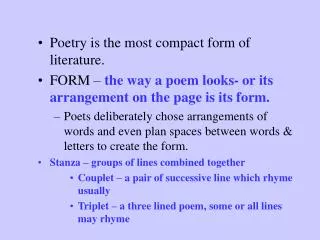
What are possible characteristics of a poem? • Figurative language – poetic language used to present regular things as unique • Metaphor • Simile • Hyperbole • Imagery • Personification • Alliteration • onomatopoeia
Metaphor – comparison of two unlike things • Simile – comparison of two unlike things using the words like, as, or than • Hyperbole – exaggeration used for emphasis • Imagery – device in which the 5 senses are using to describe • Personification – gives human qualities to unhuman things • Alliteration – repetition of consonant sounds at beginning of words • Onomatopoeia – words that sounds like what they are buzz, zip, click
What are some possible elements within a poem? • Rhyme – repetition of sounds at ends of words • Rhythm – pattern of sounds that create a beat • Caesura – a long pause in a line signaled by punctuation • Enjambment - when a line of poetry continues past the line with no punctuation
What are some types of poems? • Blank verse – unrhymed iambic pentameter; sounds like normal speech • Free verse – poetry with no particular rhyme or rhythm • Closed form – poetry with a specific rhyme and/or rhythm
Is a sentence a poem? • “The Red Wheelbarrow” • By William Carlos Williams So much depends upon a red wheel barrow glazed with rain water beside the white chickens