Discovering the Big Five: Africa’s Most Iconic and Dangerous Animals
The "Big Five" refers to five of Africa's most famous animals: the Lion, African Elephant, Cape Buffalo, Leopard, and Black Rhinoceros. Originally coined by safari hunters, this term highlights the challenge of hunting these majestic creatures. In regions where the Black Rhino is extinct, the Hippopotamus often replaces it, maintaining a complete viewing checklist for tourists. Each animal’s unique characteristics and conservation status vary, with some like the Black Rhino critically endangered, while others like the Cape Buffalo are of least concern. Explore the fascinating world of the Big Five!

Discovering the Big Five: Africa’s Most Iconic and Dangerous Animals
E N D
Presentation Transcript
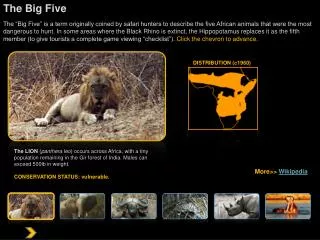
The Big Five The “Big Five” is a term originally coined by safari hunters to describe the five African animals that were the most dangerous to hunt. In some areas where the Black Rhino is extinct, the Hippopotamus replaces it as the fifth member (to give tourists a complete game viewing “checklist”). Click the chevron to advance. DISTRIBUTION (c1960) The LION (pantheraleo) occurs across Africa, with a tiny population remaining in the Gir forest of India. Males can exceed 500lb in weight. CONSERVATION STATUS: vulnerable. More>> Wikipedia
The Big Five The “Big Five” is a term originally coined by safari hunters to describe the five African animals that were the most dangerous to hunt. In some areas where the Black Rhino is extinct, the Hippopotamus replaces it as the fifth member (to give tourists a complete game viewing “checklist”). Click the chevron to advance. DISTRIBUTION (c1960) The AFRICAN ELEPHANT (loxodontaafricana) is larger than its Asian relatives, standing up to 13ft tall at the shoulder. Its life span is similar to a human. CONSERVATION STATUS: vulnerable More>> National Geographic
The Big Five The “Big Five” is a term originally coined by safari hunters to describe the five African animals that were the most dangerous to hunt. In some areas where the Black Rhino is extinct, the Hippopotamus replaces it as the fifth member (to give tourists a complete game viewing “checklist”). Click the chevron to advance. DISTRIBUTION (c1960) The CAPE BUFFALO (synceruscaffer) has an unpredictable nature and has never been domesticated, unlike the Asian Water Buffalo. CONSERVATION STATUS: least concern More>> AWF
The Big Five The “Big Five” is a term originally coined by safari hunters to describe the five African animals that were the most dangerous to hunt. In some areas where the Black Rhino is extinct, the Hippopotamus replaces it as the fifth member (to give tourists a complete game viewing “checklist”). Click the chevron to advance. DISTRIBUTION (c1960) The LEOPARD (pantherapardus) is nocturnal/crepuscular and rarely seen, even where common. Mainly found in Africa, it also occurs in various parts of Asia. CONSERVATION STATUS: near threatened More>> BBC
The Big Five The “Big Five” is a term originally coined by safari hunters to describe the five African animals that were the most dangerous to hunt. In some areas where the Black Rhino is extinct, the Hippopotamus replaces it as the fifth member (to give tourists a complete game viewing “checklist”). Click the chevron to advance. DISTRIBUTION (c1960) The BLACK RHINOCEROS (dicerosbicornis) has a reputation for being aggressive – but it has still been poached almost to extinction for its horn. CONSERVATION STATUS: critically endangered More>> WWF
The Big Five The “Big Five” is a term originally coined by safari hunters to describe the five African animals that were the most dangerous to hunt. In some areas where the Black Rhino is extinct, the Hippopotamus replaces it as the fifth member (to give tourists a complete game viewing “checklist”). Click the chevron to advance. DISTRIBUTION (c1960) The HIPPOPOTAMUS (hippopotamus amphibius) is a herbivore that feeds at night and rests in water during the day. It is the most dangerous African mammal. CONSERVATION STATUS: vulnerable More>> Wikipedia