
Affinity Housing: Creating Holistic On-Campus Living Experience
E N D
Presentation Transcript
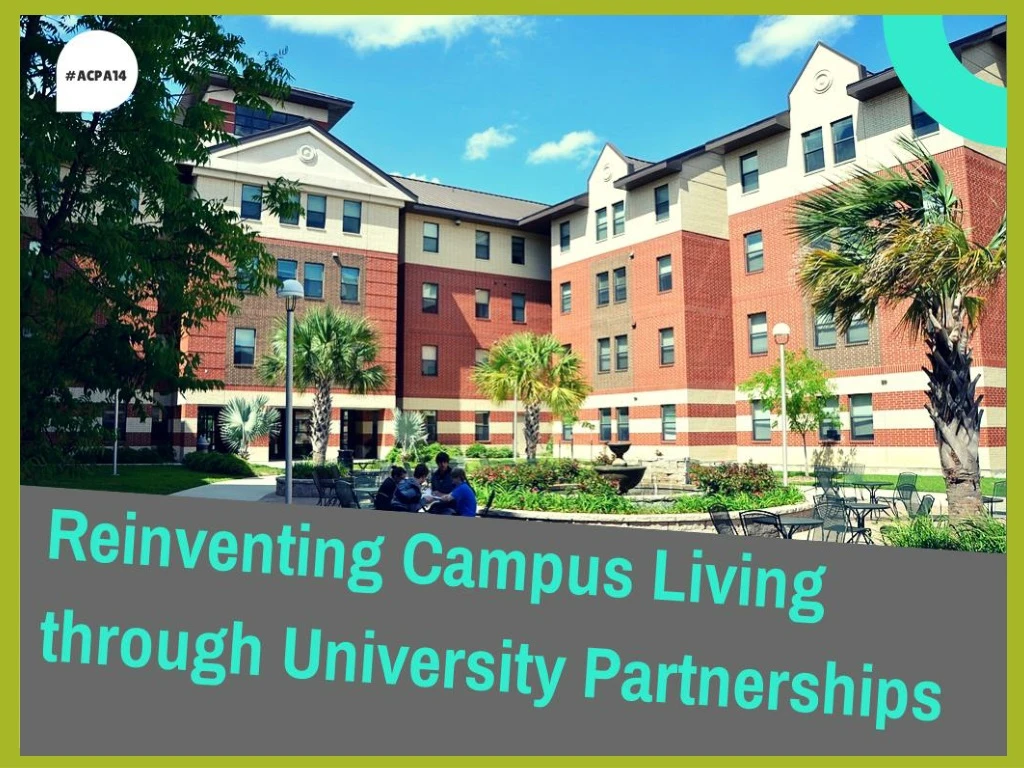
Abstract This program will discuss the University of New Orleans' newest approach to collaboration: Affinity Housing. Affinity Housing opened in Fall 2013 with four new affinity wings: iLEAD *(involvement/leadership), New Orleans Culture, Transfer Experience, and Honors. Affinity Housing was created and implemented through campus partnerships: Housing, Student Involvement and Leadership, Orientation, and First Year Experience. Through reviewing theories centered around Transformative Learning, this presentation will focus on campus partnerships that create a holistic on campus living experience for new students.
Overview • Introduction • Affinity Housing Overview • Background • Theoretical Framework • Implementation Process • Student Response • Future Growth • Collaborations • Other UNO Successes • Lessons Learned • Discussion
Background • University of New Orleans • 4 year, urban research institution in the heart of New Orleans, LA • Primarily a commuter campus • Three housing options: Pontchartrain Hall, Lafitte Village, Privateer Place • Factors Impacting the Need for Affinity Housing • First year live-on requirement implemented Fall 2013 • Poor retention rates • Need for community building • Budget limitations • “Do more with less”
Theoretical Framework • Astin’s Theory of Involvement • Investment of psychosocial and physical energy • Involvement is continuous • Involvement has qualitative and quantitative features • Development is related to quality and quantity of involvement • Educational effectiveness related to student involvement • Tinto’s Theory of Student Departure • Pre-entry attributes • Goals and commitments • Institutional experiences • Integration • Outcomes
Departmental Roles in Implementation • Student Housing • Adding Affinity Housing wing options to student housing application • Coordinating rooms by themes • Oversee the maintenance and day-to-day operations of each wing • RA training • Policy implementation • Student Involvement & Leadership • Serve as professional staff liaisons for affinity wings • One-on-one guidance to RA’s • Provide materials to assist in programming • Orientation and First Year Experience • Serve as professional staff liaisons for affinity wings • One-on-one guidance to RA’s • Promote Affinity Housing to new students • Shared Responsibilities • Marketing Affinity Housing to new students • Selection of affinity wing RA’s • Programming costs divided evenly across departments
Timeline • August 2011 – Announcement of first-year residential requirement, informal discussion regarding impact of the new policy. • August 2012 – Office discussion increased, taking into account new professional staff with diverse experiences. • September 2012 – Themed housing research began. • November 2012 – Affinity Housing survey distributed to first-year students to determine need and interest. • December 2012 – Informal discussion and brainstorming. Redesigning RA selection and training. • January 2013 – Informal meeting to determine departmental interest. • February 2013 – Formal meeting to discuss foundation. Affinity Housing committee formed. • March 2013 – RA Selection. • Summer 2013 – Promotion and implementation. • July 2013 – Student Housing transitions from Business Affairs to Student Affairs. • Fall 2013 – Continued assessment.
Affinity Housing Summary • Housing communities centered on special interest themes • iLEAD Leadership Wing • New Orleans Culture Wing • Transfer Student Wing • Honors Wing • Collaborative initiative sponsored by: • Student Housing • Student Involvement & Leadership • Enrollment Services
Student Response • 68% of students agreed with the statement “I feel that selecting Affinity Housing has positively impacted my residential living experience.” • building connections with other students as a positive outcome of living in housing • these connections “pushed [him/her] into being a big leader” and “helped [him/her] to succeed” by being with like-minded individuals, particularly in the Honors and iLEAD wings. • Personal Growth & Development • Responses were generally positive and students reported higher levels of growth and development compared to the responses of all students living on-campus.
Future Growth • Improved Theme Implementation • Increased Faculty Involvement • Sophomore-Focused Affinity Housing
Other Successful Collaborations • Privateer Camp – Enrollment Services, Student Involvement & Leadership • Transfer Retreat for Leadership (TRL) - Enrollment Services, Student Involvement & Leadership • Privateer Plunge – Enrollment Services, Student Involvement & Leadership, college departments • StrengthsQuest Committee - Enrollment Services, Student Involvement & Leadership, Counseling Services, Career Services, Athletics • First Year Interest Groups – First Year Experience, Faculty • De-Stress Fest – First Year Experience, First Year Advising, Counseling Services, Health Services, Student Involvement & Leadership • Senior Week - Student Involvement & Leadership, Alumni Affairs
Things to Consider • Don’t be limited by your departmental silos. • You are more than your title. Take into account your talents, hobbies, and experience. • Different departments will bring unique insights and approaches to the same project. • Successful collaborations involve more than interdepartmental budget transfers. • There is a difference between being open to collaborate and stepping on others’ toes. • Many collaborations begin as informal conversations between colleagues before they develop into implementable programs.
Discussion • In small groups, please discuss cross-campus collaborations of which you’ve been a part. What key factors contributed to your success? • What potential opportunities for collaboration do you see on your campus? • In larger groups, share some of the themes discussed in small groups. Brainstorm possible roadblocks and ways you might work around them.
References • Astin, A. (1993). What matters in college: Four critical years revisited. San Francisco, CA: Jossey-Bass. • Clark, M. (2014, March 07). A practical guide to institutional change. Retrieved from http://chronicle.com/blogs/future/2014/03/07/a-practical-guide-for-institutional-change/. • Tinto, V. (1993). Leaving college: Rethinking the causes and cures of student attrition. (2nd ed.). Chicago: University of Chicago Press. • Tinto, V. (2003). Learning better together: The impact of learning communities on student success. Higher Education Monograph Series, 2003-1, Higher Education Program, School of Education, Syracuse University.
Questions? Contact us. • Christy Heaton, cheaton@uno.edu • Dale O’Neill, dmoneill@uno.edu • LeeAnne Sipe, lsipe@uno.edu