Importance of Convection Scheme Over Model Resolution in Simulating the Madden-Julian Oscillation
10 likes | 132 Vues
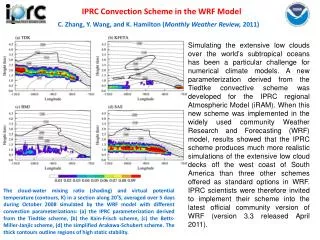
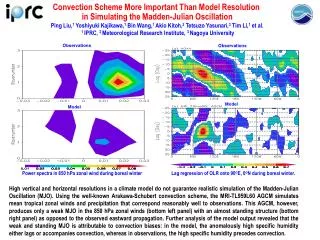
This study highlights the crucial role of the convection scheme in accurately simulating the Madden-Julian Oscillation (MJO) over the impact of model resolution. Using the MRI-TL959L60 AGCM with the Arakawa-Schubert convection scheme, we find that, despite high resolution, the model only produces a weak MJO characterized by a stationary pattern rather than the observed eastward propagation. Our analysis indicates that this discrepancy stems from biases in convection representation, particularly the timing of specific humidity changes related to convection.


Importance of Convection Scheme Over Model Resolution in Simulating the Madden-Julian Oscillation
E N D
Presentation Transcript
Convection Scheme More Important Than Model Resolution in Simulating the Madden-Julian Oscillation Ping Liu,1 Yoshiyuki Kajikawa,1 Bin Wang,1 Akio Kitoh,2 Tetsuzo Yasunari,3 Tim Li,1 et al. 1 IPRC, 2 Meteorological Research Institute, 3 Nagoya University Observations Observations Model Model Power spectra in 850 hPa zonal wind during boreal winter Lag regression of OLR onto 90oE, 0oN during boreal winter. High vertical and horizontal resolutions in a climate model do not guarantee realistic simulation of the Madden-Julian Oscillation (MJO). Using the well-known Arakawa-Schubert convection scheme, the MRI-TL959L60 AGCM simulates mean tropical zonal winds and precipitation that correspond reasonably well to observations. This AGCM, however, produces only a weak MJO in the 850 hPa zonal winds (bottom left panel) with an almost standing structure (bottom right panel) as opposed to the observed eastward propagation. Further analysis of the model output revealed that the weak and standing MJO is attributable to convection biases: in the model, the anomalously high specific humidity either lags or accompanies convection, whereas in observations, the high specific humidity precedes convection.