Exploring Lattices in Computational Domains
This document delves into the complex structures of lattices within computational domains, discussing their properties and implications for programming. It highlights the challenges of infinite height lattices and introduces alternative strategies like tuple lattices and map lattices for managing variables. The discourse includes examples showcasing operations with variables, addressing computation implications, and emphasizing sub-expression elimination. By examining these constructs, the piece aims to provide insights into effective domain design and the utilization of combinators in creating sophisticated lattice structures.

Exploring Lattices in Computational Domains
E N D
Presentation Transcript
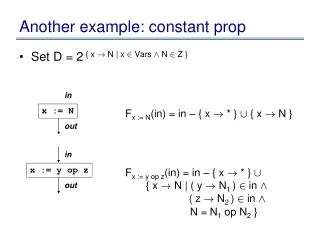
Another example: constant prop • Set D = 2 { x ! N | x 2 Vars Æ N 2 Z } in x := N Fx := N(in) = in – { x ! * } [ { x ! N } out in x := y op z Fx := y op z(in) = in – { x ! * } [ { x ! N | ( y ! N1 ) 2 in Æ ( z ! N2 ) 2 in Æ N = N1 op N2 } out
Another example: constant prop in Fx := *y(in) = in – { x ! * } [ { x ! N | 8 z 2 may-point-to(x) . (z ! N) 2 in } x := *y out in F*x := y(in) = in – { z ! * | z 2 may-point(x) } [ { z ! N | z 2 must-point-to(x) Æ y ! N 2 in } [ { z ! N | (y ! N) 2 in Æ (z ! N) 2 in } *x := y out
Another example: constant prop in *x := *y + *z F*x := *y + *z(in) = Fa := *y;b := *z;c := a + b; *x := c(in) out in x := f(...) Fx := f(...)(in) = ; out
Another example: constant prop in s: if (...) out[0] out[1] in[0] in[1] merge out
Lattice • (D, ⊑, ⊥, ⊤, ⊔, ⊓) = (2 A , ¶, A, ;, Å, [) where A = { x ! N | x ∊ Vars Æ N ∊ Z }
Example x := 5 v := 2 w := 3 y := x * 2 z := y + 5 x := x + 1 w := v + 1 w := w * v
Back to lattice • (D, ⊑, ⊥, ⊤, ⊔, ⊓) = (2 A , ¶, A, ;, Å, [) where A = { x ! N | x ∊ Vars Æ N ∊ Z } • What’s the problem with this lattice?
Back to lattice • (D, ⊑, ⊥, ⊤, ⊔, ⊓) = (2 A , ¶, A, ;, Å, [) where A = { x ! N | x ∊ Vars Æ N ∊ Z } • What’s the problem with this lattice? • Lattice is infinitely high, which means we can’t guarantee termination
Better lattice • Suppose we only had one variable
Better lattice • Suppose we only had one variable • D = {⊥, ⊤ } [ Z • 8 i ∊ Z . ⊥⊑ i Æ i ⊑⊤ • height = 3
For all variables • Two possibilities • Option 1: Tuple of lattices • Given lattices (D1, v1, ?1, >1, t1, u1) ... (Dn, vn, ?n, >n, tn, un) create: tuple lattice Dn =
For all variables • Two possibilities • Option 1: Tuple of lattices • Given lattices (D1, v1, ?1, >1, t1, u1) ... (Dn, vn, ?n, >n, tn, un) create: tuple lattice Dn = ((D1£ ... £ Dn), v, ?, >, t, u) where ? = (?1, ..., ?n) > = (>1, ..., >n) (a1, ..., an) t (b1, ..., bn) = (a1t1 b1, ..., antn bn) (a1, ..., an) u (b1, ..., bn) = (a1u1 b1, ..., anun bn) height = height(D1) + ... + height(Dn)
For all variables • Option 2: Map from variables to single lattice • Given lattice (D, v1, ?1, >1, t1, u1) and a set V, create: map lattice V ! D = (V ! D, v, ?, >, t, u)
Back to example in Fx := y op z(in) = x := y op z out
Back to example in Fx := y op z(in) = in [ x ! in(y) op in(z) ] where a op b = x := y op z out
General approach to domain design • Simple lattices: • boolean logic lattice • powerset lattice • incomparable set: set of incomparable values, plus top and bottom (eg const prop lattice) • two point lattice: just top and bottom • Use combinators to create more complicated lattices • tuple lattice constructor • map lattice constructor
May vs Must • Has to do with definition of computed info • Set of x ! y must-point-to pairs • if we compute x ! y, then, then during program execution, x must point to y • Set of x! y may-point-to pairs • if during program execution, it is possible for x to point to y, then we must compute x ! y
Common Sub-expression Elim • Want to compute when an expression is available in a var • Domain:
Common Sub-expression Elim • Want to compute when an expression is available in a var • Domain:
Flow functions in FX := Y op Z(in) = X := Y op Z out in FX := Y(in) = X := Y out
Example x := read() v := a + b w := x + 1 a = w v = a + b x := x + 1 w := x + 1 z := x + 1 t = a + b