Download
1 / 33
330 likes | 465 Vues
This paper explores the enhancement of network services through the framework of the IETF's controlled-load service architecture, aiming to improve the performance of TCP for varied application types. It distinguishes between tolerant and intolerant applications, emphasizing the need for guaranteed throughput levels, particularly for real-time and elastic applications that demand timely data delivery. By minimizing enhancements to network infrastructure, especially routers, this work outlines strategies to ensure reliable playback quality and effective congestion management.

E N D
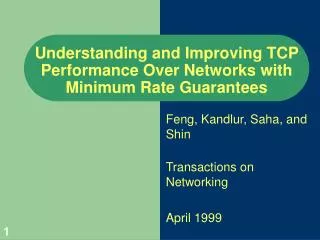
Understanding and Improving TCP Performance Over Networks with Minimum Rate Guarantees Feng, Kandlur, Saha, and Shin Transactions on Networking April 1999
Tolerant playback applications • Can tolerate some loss of fidelity • Client buffering, streaming mode • Such as PointCast, RealAudio, VDOnet,… • Quality of playback varies from excellent to intolerable, depending on the network load • Intolerant applications • Require an absolutely faithful playback and cannot tolerate loss of fidelity
Real-time applications • needs the data in each packet by a certain time and, if the data has not arrived by then, the data is essentially worthless • Elastic applications • always wait for data to arrive without time limit • Such as FTP, TELNET
Predictability in network services • To guarantee a minimum level of throughput at all time • To allow for higher throughput during periods of light load • Good for • Tolerant playback applications • Elastic applications • And others
The objective of this paper • To enhance network services within the framework of the IETF’s controlled-load service☆ architecture, but with minimum enhancements on the network infrastructure, especially the routers.☆INTSERV offers two types of services: (1) Guaranteed service (2) Controlled-load service (better-than-best-effort service)
TCP Slow Start & Congestion Avoidance • When (snd_cwnd < ssthresh) snd_cwnd = snd_cwnd + 1 (SS) • When (snd_cwnd > ssthresh) snd_cwnd = snd_cwnd + 1 / snd_cwnd (CA)
TCP Slow Start & Congestion Avoidance • When (snd_cwnd < ssthresh) snd_cwnd = snd_cwnd + 1 (SS) • When (snd_cwnd > ssthresh) snd_cwnd = snd_cwnd + 1 / snd_cwnd (CA)