Understanding Internally-Occulted Coronagraphs: Historical Insights & Scientific Objectives
180 likes | 306 Vues
This document provides an overview of internally-occulted coronagraphs, highlighting their historical development and the scientific objectives of the COR1 instrument. Key advancements in revealing the solar corona are discussed, alongside exploration of the origins of Coronal Mass Ejections (CMEs) through precise measurements of acceleration and expansion dynamics. The report also mentions potential new applications of synoptic maps in solar cycle predictions, showcasing data from multiple sources. This work aims to enhance our understanding of solar phenomena and improve CME detection methods.


Understanding Internally-Occulted Coronagraphs: Historical Insights & Scientific Objectives
E N D
Presentation Transcript
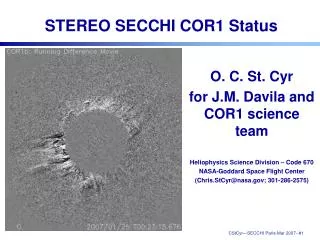
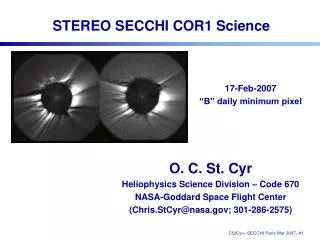
STEREO SECCHI COR1 Science 17-Feb-2007 “B” daily minimum pixel O. C. St. Cyr Heliophysics Science Division – Code 670 NASA-Goddard Space Flight Center (Chris.StCyr@nasa.gov; 301-286-2575)
Outline • Some historical notes about internally-occulted coronagraphs • Science objectives for COR1 • A new use for synoptic maps?
Bernard Lyotb. 1897 Parisd. 1952 Cairo • Noted that serious attempts to reveal the corona outside eclipse began in 1878 • Showed that diffraction from the edge of the objective lens was the primary source of stray light (Lyot stop) • Other stray light sources identified as scattering: bulk inhomogeneities; surface flaws; dust on surfaces; and surface reflections off objective front/rear (Lyot spot) • Produced working coronagraph at Pic du Midi during the 1930’s
COR1 Optical System Overview Doublet 2 • All refractive design in an axial package Aperture & Objective Lyot Stop, Doublet 1, & Filter Occulter & Field Lens Polarizer Mask, Shutter, & CCD • Three cascaded imaging systems: • Objective lens forms a solar/coronal image at the occulter • Field lens images the front aperture onto the Lyot Stop • Pair of doublets relays the coronal image onto the CCD • Seven spherical lenses, Rad Hard materials • (1 singlet, 3 cemented doublets) • 1.2 meters long
MLSO Groundbased White-Light Coronagraph(Internally-occulted)
Green-Line (FeXIV) Coronagraph(Reflecting, Internally-occulted) PICO (Pic Du Midi Coronagraph) SOHO LASCO C1 MICA (MIrror Coronagraph for Argentina)
Outline • Some historical notes about internally-occulted coronagraphs • Science objectives for COR1 • A new use for synoptic maps?
COR1 Primary Science Goal: Understanding the Origin of CMEs • There are four parameters that are critical to understanding the origins of CMEs and the forces acting on them. But these are difficult to measure above 2 RS (depicted by white circle). • initial acceleration • non-radial motions • transverse (latitudinal) expansion • initial radial expansion 1998-06-02 SOHO EIT (195A) and LASCO C2 (Plunkett et al, 2000)
Outline • Some historical notes about internally-occulted coronagraphs • Science objectives for COR1 • A new use for synoptic maps?
Solar Maximum Total Eclipse of 16 February 1980 Palem, India
Solar Minimum SOHO LASCO C2 02-Feb-1996
MLSO MK3 pB West Limb Synoptic Maps (1980-1999) N90° R=1.25 RSun Equator S90° N90° R=1.75 RSun Equator S90°
MLSO MK3 pB West Limb Synoptic Maps (1980-1999) R=1.75 RSun 27-day Average 2800 MHz Adjusted Flux
Jan1980 CR1691 Aug1999 CR1953 Time MLSO MK3 (pB) R=2.0 RSun Equator SMM C/P (B) R=2.0 RSun SOHO LASCO C2 (B) R=2.5 RSun Oct2006 CR2044 Jan1996 CR1905 Feb1980 CR1693 Oct1989 CR1822 Time Time C. St. Cyr – 22Dec2006
Conclusions 17-Feb-2007 “pB” daily minimum pixel • New data sources with constantly-changing vantage points! • More than 25 CMEs already detected by both COR1-A and COR1-B • Solar cycle prediction from synoptic maps!