Download
1 / 21
210 likes | 353 Vues
This article discusses the intricate role of HLA class I antigens in tumor biology, focusing on their expression, defects in malignant cells, and the resulting impact on T-cell recognition and immunotherapy outcomes. Our findings reveal that HLA class I antigen expression is influenced by signaling transduction pathways and treatments like chemotherapy and radiotherapy. Understanding these mechanisms is crucial for improving immunotherapeutic approaches, particularly with checkpoint inhibitors, and highlights the importance of identifying biomarkers for patient selection in cancer therapy.

E N D
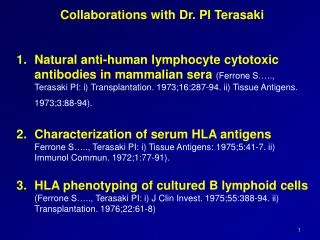
Collaborations with Dr. PI Terasaki Natural anti-human lymphocyte cytotoxic antibodies in mammalian sera (Ferrone S….., Terasaki PI: i) Transplantation. 1973;16:287-94. ii) Tissue Antigens. 1973;3:88-94). Characterization of serum HLA antigens Ferrone S….., Terasaki PI: i) Tissue Antigens: 1975;5:41-7. ii) ImmunolCommun. 1972;1:77-91). HLA phenotypingofcultured B lymphoidcells(Ferrone S….., Terasaki PI: i) J ClinInvest. 1975;55:388-94. ii) Transplantation. 1976;22:61-8)
HLA class I antigens in tumor cells ( Enthusiasm phase Renaissance phase Indifferent phase Anti-CTLA4 Anti-PD-1 Anti-PD-L1 Hybridoma methodology Many HLA class I-specific mAbs Clinical applications 1978-1990 1991-2011 2012-
Information in the literature Defects in HLA class I antigens found in most if not all malignancies analyzed Characterization of the multiple molecular mechanisms underlying HLA class I antigen defects in malignant cells Assessment of the clinical significance of the HLA class I antigen defects found in malignant cells
HLA class I antigens in tumor cells ( Indifferent phase Enthusiasm phase Renaissance phase Anti-CTLA4 Anti-PD-1 Anti-PD-L1 Hybridoma methodology Many HLA class I-specific mAbs Clinical applications 1978-1990 1991-2011 2012-
ERK1/2 activation in melanoma cells with a constitutively active BRAF-mutated 6
HLA Class I antigen up-regulation by BRAF-I and IFNα-2b on melanoma cells with an active BRAF-mutated SK-MEL-37 HLA Class I mAb TP25.99 HLA B/C mAb B1.23.2 BRAF-I IFNα-2b
HLA Class I APM component up-regulation by EGFR-specific mAbcetuximab in the head and neck squamous cancer cell line JHU-029
HLA-A2-MAGE-3 peptide complex up-regulation by EGFR-specific mAbcetuximab in the head and neck squamous cancer cell line JHU-029
HLA Class I APM component up-regulation by docetaxel in human cancer cell lines
Increased sensitivity to cognate CTL of human cancer cell lines treated with docetaxel
HLA Class I APM component up-regulation by radiation in human cancer cell lines
Conclusions • HLA class I antigen expression by malignant cells is modulated by signaling transduction pathways, chemotherapy and radiotherapy. • These changes are associated with an increased T cell recognition and destruction of cancer cells.
HLA class I antigens in tumor cells ( Renaissance phase Indifferent phase Enthusiasm phase Anti-CTLA4 Anti-PD-1 Anti-PD-L1 Hybridoma methodology Many HLA class I-specific mAbs Clinical applications 1978-1990 1991-2011 2012-
Targeting Immunoregulatory Molecules in Cancer Figure adapted from A. Ribas, NEJM, 2012
Conclusions • Immunotherapy with check point molecule-specific mAb induces dramatic and long lasting responses, but only in up to 30% of patients. • These findings emphasize the need to identify biomarkers to select patients who may benefit from this therapy • HLA class I antigen expression by malignant cells may be a useful biomarker since defects in HLA class I antigen expression may protect tumor cells.
HLA class I antigen defects in malignant cells Soldano Ferrone, MD, PhD Departments of Surgey and Orthopedic Surgery Massachusetts General Hospital, Harvard Medical School, Boston, MA (USA)
Acknowledgements • Francesco Sabbatino, MD, PhD • Cristina R. Ferrone, MD • James Hodge, PhD (NCI, Bethesda, MD) • Robert L. Ferris, MD, PhD (University of Pittsburgh, Pittsburgh, PA)
Model of HLA Class I APM component up-regulation by docetaxel in human cancer cell lines
HLA Class I antigen up-regulation by EGFR-specific mAbcetuximab on the head and neck squamous cancer cell line JHU-029