Molecular Geometry
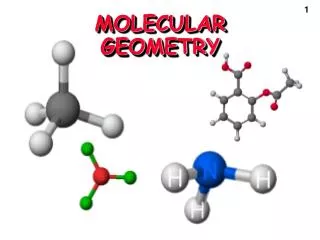
This overview covers key concepts in molecular geometry as per VSEPR theory. It explains how electron pairs repel to determine molecular shape and examines different geometries such as linear (e.g., F2, HCl), trigonal planar (e.g., BH3), tetrahedral (e.g., CH4), bent or angular (e.g., H2O), and trigonal pyramidal (e.g., NH3). Additionally, it differentiates between polar and nonpolar molecules, highlighting how electron distributions result in partial charges in polar molecules like H2O versus the even distribution in nonpolar molecules such as CH4.

Molecular Geometry
E N D
Presentation Transcript
Molecular Geometry NCSCOS Essential Standard Chm 1.2.3
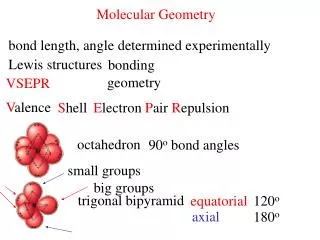
I. VSEPR Theory • Valance Shell Electron Pair Repulsion • Gives molecules their shape • Pairs of electron repel to be as far apart as possible
II. Shapes (Geometries) • Linear • A2 ex: F2 • AB ex: HCl • AB2 (with a double bond) ex: CO2 carbon dioxide
Trigonal Planar • AB3 • no unshared pairs of electrons • Usually occurs w/ elements that do not fulfill the octet rule (ex: B) • BH3
Tetrahedral • AB4 • No unshared pairs of electrons • Ex: CH4
Bent or Angular • AB2E2 • 2 unshared pairs of electrons • Ex: H2O = OH2
Trigonal Pyramidal • AB3E • 1 pair of unshared electrons • Ex: NH3
III. Molecule Polarity • Polar Molecules: opposite ends of the molecule contain opposite partial charges. • Electrons are not distributed evenly across the molecule • Ex: H2O • All molecules that have E, and some linear.
Nonpolar Molecules: no opposite charges • Electrons are evenly distributed across the entire molecule • All molecules that do not have an E & diatomic molecules. • Ex: CH4 • Ex: Cl2