Machine Learning with Weka
Learn about the WEKA software, a Java-based machine learning toolkit with pre-processing tools, algorithms, and evaluation methods. Explore the various versions, resources, and Weka-related projects to enhance your machine learning skills. Discover how to import and preprocess data, build classifiers, and try different learning schemes to improve your predictive models.

Machine Learning with Weka
E N D
Presentation Transcript
Machine Learning with Weka Cornelia Caragea Thanks to Eibe Frank for some of the slides
Weka: A Machine Learning Toolkit Preparing Data Building Classifiers Outline
WEKA: the software Machine learning/data mining software written in Java (distributed under the GNU Public License) Used for research, education, and applications Main features: Comprehensive set of data pre-processing tools, learning algorithms and evaluation methods Graphical user interfaces (incl. data visualization) Environment for comparing learning algorithms
WEKA: versions There are several versions of WEKA: WEKA: “book version” compatible with description in data mining book WEKA: “GUI version” adds graphical user interfaces (book version is command-line only) WEKA: “development version” with lots of improvements
WEKA: resources API Documentation, Tutorials, Source code. WEKA mailing list Data Mining: Practical Machine Learning Tools and Techniques with Java Implementations Weka-related Projects: Weka-Parallel - parallel processing for Weka RWeka - linking R and Weka YALE - Yet Another Learning Environment Many others…
Weka: web site http://www.cs.waikato.ac.nz/ml/weka/
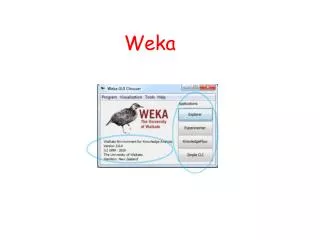
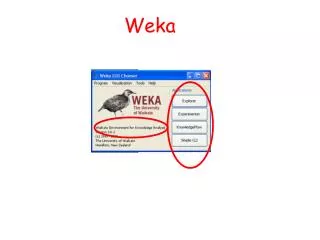
WEKA: launching java -jar weka.jar
Outline Weka: A Machine Learning Toolkit Preparing Data Building Classifiers
@relation heart-disease-simplified @attribute age numeric @attribute sex { female, male} @attribute chest_pain_type { typ_angina, asympt, non_anginal, atyp_angina} @attribute cholesterol numeric @attribute exercise_induced_angina { no, yes} @attribute class { present, not_present} @data 63,male,typ_angina,233,no,not_present 67,male,asympt,286,yes,present 67,male,asympt,229,yes,present 38,female,non_anginal,?,no,not_present ... WEKA only deals with “flat” files Flat file in ARFF format
@relation heart-disease-simplified @attribute age numeric @attribute sex { female, male} @attribute chest_pain_type { typ_angina, asympt, non_anginal, atyp_angina} @attribute cholesterol numeric @attribute exercise_induced_angina { no, yes} @attribute class { present, not_present} @data 63,male,typ_angina,233,no,not_present 67,male,asympt,286,yes,present 67,male,asympt,229,yes,present 38,female,non_anginal,?,no,not_present ... WEKA only deals with “flat” files numeric attribute nominal attribute
Explorer: pre-processing the data Data can be imported from a file in various formats: ARFF, CSV, binary Data can also be read from a URL or from an SQL database (using JDBC) Pre-processing tools in WEKA are called “filters” WEKA contains filters for: Discretization, normalization, resampling, attribute selection, …
Outline Weka: A Machine Learning Toolkit Preparing Data Building Classifiers
Explorer: building “classifiers” Classifiers in WEKA are models for predicting nominal or numeric quantities Implemented learning schemes include: Decision trees, support vector machines, perceptrons, neural networks, logistic regression, Bayes nets, … “Meta”-classifiers include: Bagging, boosting, stacking, …
Outline Machine Learning Software Preparing Data Building Classifiers
To Do Try Naïve Bayes and Logistic Regression classifiers on a different Weka dataset Use various parameters Try Linear regression