Download
1 / 9
90 likes | 220 Vues
The 1960 election marked a pivotal moment in U.S. history, with John F. Kennedy and Richard Nixon vying for the presidency in a Cold War climate. For the first time, television played a critical role in shaping public perception of candidates. Kennedy's "New Frontier" agenda aimed to address key issues, including education, healthcare for the elderly, and urban affairs. His presidency witnessed significant legislative achievements, alongside challenges from within his party. The Warren Court's landmark rulings also transformed civil rights and individual liberties during this era.

E N D
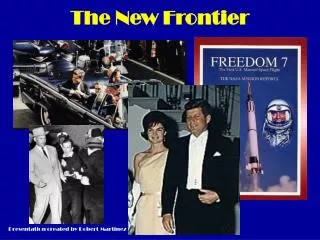
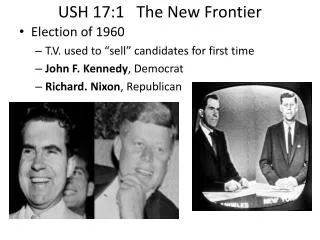
USH 17:1 The New Frontier • Election of 1960 • T.V. used to “sell” candidates for first time • John F. Kennedy, Democrat • Richard. Nixon, Republican
Issues in the Election • Both were “Cold Warriors” • Determined to stop communist aggression • “Missile Gap” • Belief the U.S. was behind Soviets in weaponry • Kennedy’s Catholicism • Worries Catholic Church would guide Kennedy
Kennedy Takes Office • 35th president: John F. Kennedy (1961-1963) • “New Frontier” • Kennedy’s legislative agenda • Increase aid to education • Provide health insurance to elderly • Create Department of Urban Affairs
Successes and setbacks • Democrats controlled both House and Senate • Many Democrats not loyal to Kennedy • No “coattails” • Southern Democrats thought “New Frontier” was too expensive • Expands economy • Government invests in defense and space programs
Successes and Setbacks • Raised minimum wage • Housing project for low-income areas • Equal Pay Act of 1963 • Women paid same as men for same work • Created programs to help people with disabilities
Warren Court Reforms • Earl Warren, Chief Justice of the Supreme Court • Rulings re-shape American politics and society
Warren Court-Civil Rights • Brown v Board of Education (1954) • Segregation in public schools unconstitutional • Heart of Atlanta Motel v U.S. (1964) • Segregation illegal in public accommodations • Loving v Virginia (1967) • States cannot ban interracial marriages
Warren Court – Due Process • Mapp v Ohio (1961) • Unlawfully seized evidence cannot be used at trial • Gideon v Wainwright (1963) • Right to a court-appointed attorney • Escobedo v Illinois (1964) • Right to an attorney during police questioning • Miranda v Arizona (1966) • Informed of your rights if arrested
Warren Court – Freedom of Speech / Religion • Engel v Vitale (1962) • Banned state-mandated prayer in public schools • Albington School District v Schempp(1963) • Banned state-mandated bible readings in school • N.Y. Times v Sullivan (1964) • Limited when celebrities could sue the media