Download

1 / 16
0 likes | 11 Vues
Sound is produced through vibrations transmitted to our ears, allowing us to perceive pleasant or unpleasant sounds. Music, a form of organized sound, includes elements like pitch, dynamics, tone color, and duration. These elements contribute to the unique character of musical pieces, influencing how we perceive and enjoy them.

E N D
Elements of Sound

Sounds may be perceived as pleasant or unpleasant. What are these sounds that we hear? What is "sound"? What causes it, and how do we hear it? Sound begins with the vibration of an object, such as a table that is pounded or a string that is plucked. The vibrations are transmitted to our ears by a medium, which is usually air. As a result of the vibrations, our eardrums start vibrating too, and impulses, or signals, are transmitted to the brain. There the impulses are selected, organized, and interpreted. Music is part of this world of sound, an art based on the organization of sounds in time.

Properties of musical sounds We distinguish music from other sounds by recognizing the four main properties of musical sounds: • Pitch • Dynamics • Tone color or Timbre • Duration

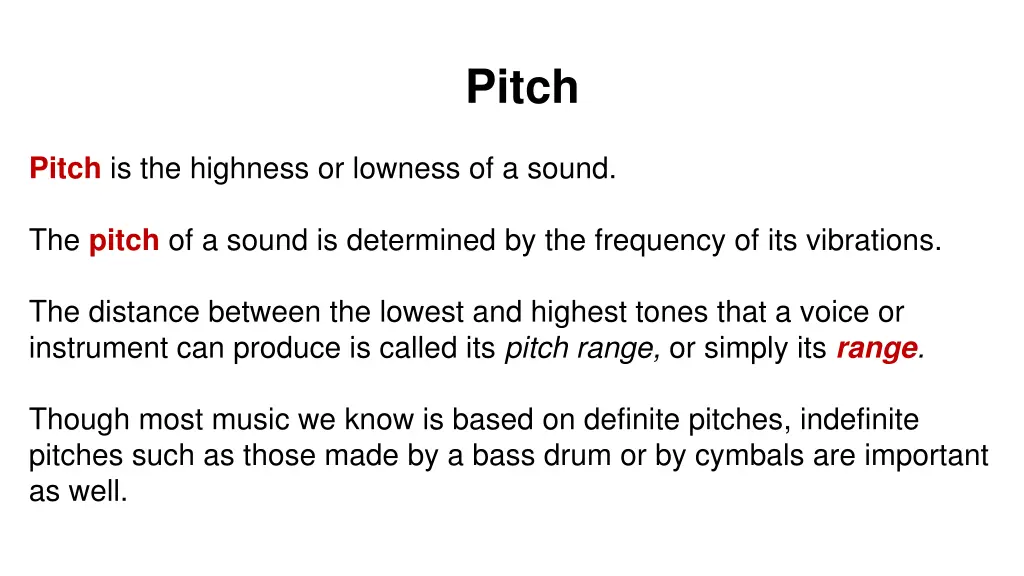
Pitch Pitch is the highness or lowness of a sound. The pitch of a sound is determined by the frequency of its vibrations. The distance between the lowest and highest tones that a voice or instrument can produce is called its pitch range, or simply its range. Though most music we know is based on definite pitches, indefinite pitches such as those made by a bass drum or by cymbals are important as well.
Dynamics Dynamics: Degrees of loudness or softness in music are called dynamics. Loudness is related to the amplitude of the vibration that produces the sound. The harder a guitar string is plucked (the farther it moves from the fingerboard), the louder its sound. When instruments are played more loudly or more softly, or when there is a change in how many instruments are heard, a dynamic change results; such a change may be made either suddenly or gradually.

In musical notation, dynamics are indicated with the following Italian words and their abbreviations: pp p mp Pianissimo Piano Mezzo piano Mezzo forte mf Forte Fortissimo very soft soft Moderately soft Moderately loud Loud Very loud f ff Crescendo: A gradual increase in loudness. It often creates excitement, particularly when the pitch rises too. Decrescendo: a gradual decrease in loudness. It can be used to convey a sense of calm.

Timbre-Tone Color We can tell a trumpet from a flute even when each of them is playing the same tone at the same dynamic level. The quality that distinguishes them is called tone color, or timbre. Tone color is described by words like bright, dark, brilliant, mellow, and rich. Like changes in dynamics, changes in tone color create variety and contrast. When the same melody is played by one instrument and then by another, it takes on different expressive effects because of each instruments tone color. On the other hand, a contrast in tone color may be used to highlight a new melody: after violins play a melody, an oboe may present a contrasting one. Tone colors also build a sense of continuity; it is easier to recognize the return of a melody when the same instruments play it each time.

Duration Duration is the length of time a pitch, or tone, is sounded. For patterns of duration, the following term is used: Rhythm.

Rhythm Rhythm is the flow of music through time. Rhythm can be defined as the particular arrangement of note lengths in a piece of music. The rhythm of a melody is an essential feature of its personality. Rhythm has several interrelated aspects: Beat • Meter • Tempo •

Beat Beat is a regular, recurrent pulsation that divides music into equal units of time. When you clap your hands or tap your foot to music, you are responding to its beat. A note may last a fraction of a beat, an entire beat, or more than a beat.

Meter In music we find a repeated pattern of a strong beat plus one or more weaker beats. The organization of beats into regular groups is called meter. A group containing a fixed number of beats is called a measure. There are several types of meter, which are based on the number of beats in a measure. When a measure has 2 beats, it is in duple meter; we count 12, 12, . A pattern of 3 beats to the measure is known as triple meter. All waltzes are in triple meter, we count 123, 123, etc.

Tempo Tempo is the speed of the beat, the basic pace of the music. A fast Tempo is associated with a feeling of energy, drive, and excitement. A slow Tempo often contributes to a solemn, lyrical, or calm mood. A Tempo Indication is usually given at the beginning of a piece. As with dynamics, the terms that show tempo (at the left) are in Italian.

Largo Grave Adagio Andante Moderato Allegretto Allegro Presto Very slow, broad Very slow, solemn Slow Moderately slow Moderate Moderately fast Fast Very fast A gradual quickening of tempo may be indicated by writing Accelerando (becoming faster), and a gradual slowing down of tempo by Ritardando (becoming slower). An Accelerando, especially when combined with a rise in pitch and volume, increases excitement, and a Ritardando is associated with less tension and a feeling of conclusion.

Melody After hearing a piece of music, we usually remember its melody best. Melody is a series of single tones which add up to a recognizable whole. A melody begins, moves, and ends; it has direction, shape, and continuity. The up-and-down movement of its pitches conveys tension and release, expectation and arrival. This is the melodic curve, or line. A melody moves by small intervals called steps or by larger ones called leaps. A step is the interval between two adjacent tones. Any interval larger than a step is a leap. Besides moving up or down by step or leap, a melody may simply repeat the same note. A melody’s range is the distance between its lowest and highest tones. Range may be wide or narrow. -Melodies written for instruments tend to have a wider range than those for voices, and they often contain wide leaps and rapid notes that would be difficult to sing. How the tones of a melody are performed can vary its effect, too. Sometimes they are sung or played in a smooth, connected style called Legato. Or they may be performed in a short, detached manner called Staccato.

Harmony When folksingers accompany themselves on a guitar, they add support, depth, and richness to the melody. We call this harmonizing. Most music in western culture is a blend of melody and Harmony. Harmony refers to the way chords are constructed and how they follow each other. A Chord is a combination of three or more tones sounded at once. Essentially, a Chord is a group of simultaneous tones, and a Melody is a series of individual tones heard one after another.

Texture Monophonic Texture When we hear one main melody without accompaniment, the texture is Monophonic. Homophonic Texture When we hear one main melody accompanied by chords, the texture is Homophonic. Polyphonic Texture Simultaneous performance of two or more melodic lines of relatively equal interest produces the texture called Polyphonic, meaning having many sounds. In polyphony several melodic lines compete for attention.













![Read ebook [PDF] Sound Medicine: How to Use the Ancient Science of Sound to Heal the Body and](https://cdn7.slideserve.com/12550224/slide1-dt.jpg)