Building Sustainable Regional Bridges Through Collaborative Food Cooperatives
This initiative emphasizes the importance of community-driven food cooperatives in fostering sustainable local economies. By supporting over 17 member food co-ops across New England, which collectively serve over 64,000 members, the Neighboring Food Cooperative Association (NFCA) promotes local products, creates jobs, and contributes significantly to state economies. This collaborative effort aims to strengthen regional food systems, enhance community engagement, and prepare for future challenges such as climate change, all while maintaining equitable access to resources.

Building Sustainable Regional Bridges Through Collaborative Food Cooperatives
E N D
Presentation Transcript
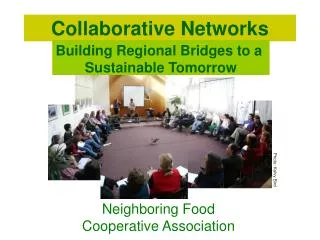
Collaborative Networks Building Regional Bridges to a Sustainable Tomorrow Photo: Kelvy Bird Neighboring FoodCooperative Association
Neighboring • “A viable neighborhood is a community;and a viable community is made up ofneighbors who cherish and protectwhat we have in common.” • Wendell Berry
Sponsoring Cooperative Organizations • Cooperative Fund of New England • Funding the co-operative economy since 1975. • NationalCooperative GrocersAssociation • Putting it all together for food co-ops.
New Hampshire Concord Cooperative MarketConcord Hanover Co-op Food Store;Community Food MarketHanover Lebanon Co-op Food StoreLebanon Littleton Food Co-opLittleton (Coming Soon!) Massachusetts Green Fields MarketGreenfield Leverett Village Co-opLeverett McCusker's MarketShelburne Falls River Valley MarketNorthampton Wild Oats Food Co-opWilliamstown Member Food Co-ops • Vermont • Brattleboro Food Co-opBrattleboro • Buffalo Mountain Co-opHardwick • City Market/Onion River Co-opBurlington • Dottie's Natural Foods Discount Brattleboro • Hunger Mountain Food Co-opMontpelier • Middlebury Natural Foods Co-opMiddlebury • Putney Food Co-opPutney • Rutland Natural Food MarketRutland • South Royalton Food Co-opSouth Royalton • Springfield Food Co-opSpringfield • Upper Valley Food Co-opWhite River Junction
Neighboring Food Cooperative Association • 17 food co-ops, owned and democratically governed by over 64,000 members. • NFCA members account for 7% of the population of host counties • Have Sales of $161 million • Purchased over $33 million in local products • …Including $10 million in fresh farm products, $18 million in locally-processed foods, and $5 million in other products. • Employ over 1,240 staff… • Taken together, member food co-ops in VT are one of the top 25 employers in the state. • Paid over $28.6 million in employee wages… • Average wage was 18% higher than the average for other food and beverage stores in the same states. • Supported local government through payment of taxes… • Including $7.3 million in sales, excise and other taxes, $434,000 paid by employees, and $500,000 in property taxes.
Neighboring Food Co-ops & the Regional Economy Local Products & Services Local Employment State & Local Government Community Food Co-ops Co-op Members & Shoppers
Scenario Planning • The Art of the Long View • Peter Schwartz • Diverse, plausible stories • Not about predicting the future • Consider implications of each story
The Regional Economy Circa 2020 What is the future of the regional economy?
Driving Forces • Climate change • Market-based sustainability strategies strongly promoted • Shifts in global resource landscape • Young people passionate about living their values • YouTube generation and democratization of media • Powerful interests inhibit community creativity • Decreasing access to farmland • Grounded hope
Critical Uncertainty How will communities respond?
Two Regional Futures • More of the same, deal with it • We’re still here, the ones we’ve been waiting for
Building Bridges • Not reinventing the wheel • Active collaboration: • Co-op Sector • Regional Sustainability Organizations • Local Food System
Strategic Approach • Decentralization • Import Substitution • Identifying ‘white spaces’ • Relationship-building
Long-term Desired Outcomes Overarching Desired Outcome Entry Points into Regional Economy Primary StrategicGoal Thriving Regional Economy Collaborative Region-wide Community Vibrant, Integrated Co-op Sector Healthy Local Food System
The Regional Food System PROCESSING PRODUCTION DISTRIBUTION: MARKETING WASTE & NUTRIENT MANAGEMENT CHANGE AGENT NFCA DISTRIBUTION: TRANSPORTATION CONSUMPTION NFCA Food Co-op Member-owners DISTRIBUTION: SOURCING NFCA Member Food Co-ops Based on Components of a Food System (Nickerson, 2008)
NFCA Role: Change Agent • Regional Need • Communication and Coordination • Channels • Education • Research • Innovation • Investment • Policy