Download
1 / 29
300 likes | 421 Vues
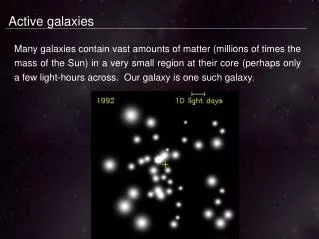
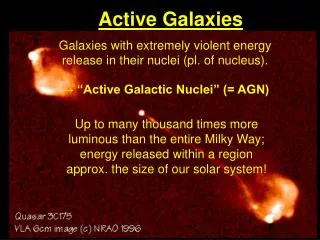
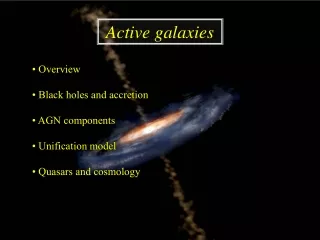
Active galaxies are a fascinating class of astronomical objects characterized by exceptionally high energy output and unique emission spectra. These galaxies exhibit non-thermal emissions, primarily from central supermassive black holes, resulting in phenomena like broad emission lines and polarized radiation. Comprising various types, including Seyferts and quasars, active galaxies can feature explosive jets and rapid variability. Our exploration covers their defining traits, energy types, and the intricate processes guiding their formation and evolution across cosmic time, thus shedding light on their role in the universe.

E N D
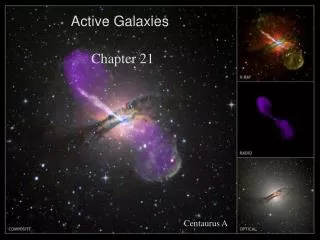
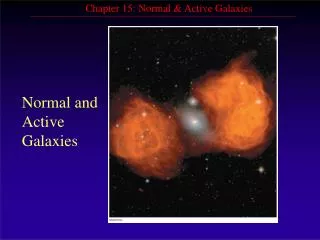
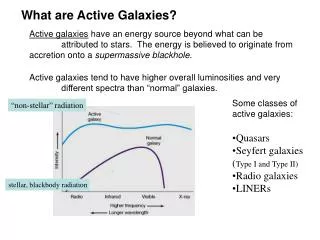
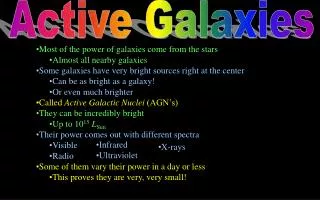
Active Galaxies • Definition – • Amount of Energy • Type of Energy • Non-thermal • Polarized • Other characteristics • Emission spectra • Hydrogen – Balmer series & Lyman alpha (121.6 nm), UV • N V (124.0 nm) • C IV (154.9 nm) • O VI (103.5 nm) • Forbidden emission lines
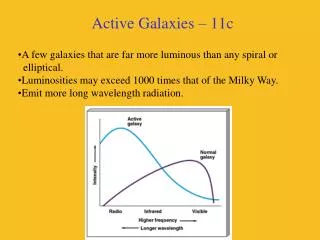
Synchrotron radiation F(n)=Fon-a a between 0.7 and 1.2 Active galaxy general characteristics - • L>1037 W (>10 billion L) • Non-thermal emission • Excessive amount of IR, UV, radio, x-ray • Small region of rapid variability • Bright nucleus • Explosive appearance/Jets • Broad emission lines
ULIRG • Very high redshift (z) • Very young/early galaxies • Lots of IR/dust • Lots of star formation • Earliest of all galaxies?
Seyferts • Characteristics • Bright nuclei, 100 billion L • Spiral like (90%) • 10% Normal spirals have Seyfert characteristics • Non-thermal, synchrotron continuum • Two different types • Type I • More common • Wide spectral features – high velocity • More luminous • UV, x-ray
Type 2 • Narrow emission lines • Strong in IR • Range of types, 1.5, 1.7, etc. Model? • Accretion disk (non-thermal) • High energy photons (x-ray, uv) • Black hole • Jets • Radio, or boosted to higher energies • Dust – IR source for type 2 • High/low velocity clouds
Type 1 Type 1.5 Type 2
Radio Galaxies • 1% of all galaxies • 10% of active • Level of emission is used to classify • Two groups • Compact • Extended • Jets – synchrotron, bipolar outflow • Lobes, 50-3000 kpc, electrons, protons
3 types of extended radio galaxies • Classical double lobes • High luminosity • cD galaxies, ellipticals • Wide-angle tails, bent tails • Narrow tail sources • Low luminosity, high velocity galaxies • Compact sources have different energy profile (a ~ 0)
Cygnus A 100 kpc Radio, x-ray images
M87 3 billion M Black hole
M87 both X-ray radio
Quasars • Quasi-stellar objects (QSOs) • Characteristics • Star-like appearance • Broad emission lines • Absorption lines, especially if z>2 • Other absorption features • Broad features with velocities up to 0.2 c • Low velocity sharp lines – absorption/emission • Lyman – alpha forest – wide range of velocities
Most quasars visible light sources, or higher energy (x-ray, gamma-ray) • Non-thermal spectrum (a between 0, 1.6) • Variable – quick • High z values • Quasar evolution • Brightness varies with z (brighter at high z) • Very few at very high z • Peak at z~2.5 (1000x more/volume than today) • Peak of 1 QSO per 100 Mpc3
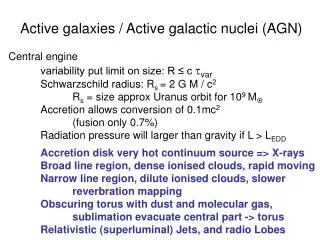
Unified Model • Look at model for Seyferts • Can be applied to all types of active galaxies • Must have a black hole! • Million – billions of M • Infall rates of 100 M /year needed • High luminosities – short lived
History? Step 1. First objects formed – what were they? ULIRG or Quasars or regular Galaxies? ULIRG Rare, hard to find QSOs – stand out, but not common at very high z Most distant object observed, z=10 (maybe) Step 1a. Formation of first galaxies, z=5-8? With massive black holes? First QSOs formed also (not all galaxies are QSOs) Step 2. Peak of QSO formation at z=2.5
Step 3. QSOs start to fade Not feeding them enough Step 4. QSOs become Seyferts? Or Radio? Less powerful, logical step Seyfert phase – relatively short Whole AGN phase – few billion years? Step 5. Normal, boring galaxies, with no major activity
Feeding the Monster Black hole powers AGNs Can you over feed a black hole? Yes! Radiation pressure limits infall Eddington Luminosity – LEdd = 3 x 10⁴ (MBH/M) L
Most distant object? Abell 1835 IR1916 z=10! Much smaller than MW!
Most distant QSO SDSS J1148+5251 z=6.42
How many quasars? Lynx arc