
Unit 3 – Vocal Performance
E N D
Presentation Transcript
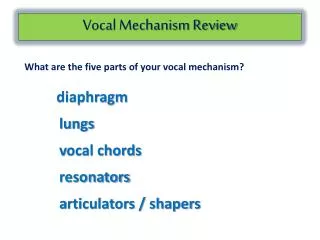
Proper Breathing • Lungs should not do most of the work • The diaphragm is the muscle that keep the air flowing • Separates the thoracic cavity from the abdominal cavity • When contracted the diaphragm moves down • When relaxed the diaphragm it moves up • Stomach should push out when breathing in • Diaphragm is pulling down, ribcage widening from bottom • Stomach should suck in when breathing out • Stomach muscles are contracting • Avoid thoracic breathing technique
Air Flow • Once the lungs fill, the air is push upward through the trachea • Air then passes to the larynx and the vocal folds • Vocal folds are relaxed and open in silence • Vocal folds tighten and come together in speech • The air flow through the folds causes them to vibrate rapidly • Air then goes through the trachea into the head and mouth • Bones and sinuses in the head serve as resonators • Parts of the mouth serve as articulators
Posture • When standing: • Feet apart • Weight slightly on balls of feet • Knees slightly flexed • Hips straight, Back straight • Chest and Shoulders should not rise • When seated: • Sit toward edge of chair • Feet flat • Back straight
Volume • Loudness or Softness of one’s voice • Contributes to energy and enthusiasm • Can be controlled by muscles and microphone • A soft voice that is boosted will still be weak and lifeless • Projection is the process of pushing sound out of your mouth • Push with your stomach muscles to speak to the back of the room • Variety between loud and soft helps the speaker to talk to the audience rather than at the audience
Pitch • Highness and lowness of your voice • Use your full pitch range with emphasis on lower end of voice • Don’t use an “announcer’s” voice • Go about ¼ up from your lowest pitch
Rate • Number of words per minute you deliver during a period of time • Typical rate is 160-180 wpm • The faster you go, the more mistakes you make
Tone • Quality of the sound made • Also known as timbre (tam-ber) • Affected most by the surrounding of the vibrators • “Resonators” • Relax enough to allow the sound to resonate • Humming • Bridge of nose • Fingers on either side of nose under eyes • Say ah • Move tongue to block
Articulation • Shaping sounds into recognizable words • Lips, teeth, tongue, jaw, hard palate, soft palate • Be clear, not overly precise • Most common issue is lazy mouth • “Let’s take the local bus to that market” • Tongue position • Relaxed jaw • Unclenched teeth • Exercise the articulators • Drink water
Pronunciation • The way words are spoken by uttering the proper sound and stressing the proper syllable • Pronunciation = accent Enunciation = clarity • Determine the accepted form, make sure you get it right • Standard American English is the standard • Mispronunciations cause alienations and loss of credibility • Use pronunciation guides, use practice • A = uh the = thu • Foreign names, places, lakes, are killers • Phonetic spelling
Substandard Pronunciation • Omission – leave out part of word • Dropping off g • Additions – adding sound to word • Warshington • Substitution – replacing with wrong sound • Mudder, budder • Distortion – slightly altering correct sound • Fergit, jist • Slurring – running words together • Whatchadoin’
Common Vocal Problems • Filler: Unnecessary words used while thinking of message • “um, uh, ya know” • Monotone: lack of variance in pitch • Boring and uninteresting • Sing-song: repeated pattern of pitch • Whiny: too high, nasal pitch, elongated vowels • Choppy: repeated pattern of pause
Common Vocal Problems • Nasality: air is blocked from resonators by tongue or soft palate • Relax Jaw • Thin Voice: lacks resonance and is weak • Diaphragmatic breathing • Breathy Voice: lack of vibration, overly airy • Let air out slower • Husky Voice: harsh and unpleasant, caused by misuse of voice • Use higher pitch
Common Vocal Problems • Sibilance – fricative sounds (s, z, f,) are overemphasized • Popping: plosive sounds (p, b, t, d, k) are overemphasized
Voice Maintenance • Avoid screaming • Adequate moisture • Avoid coffee, dairy, alcohol, caffeine • You are using a microphone • Save your voice
Conversational Style • Difficult to achieve because: • No other people in booth • No immediate feedback from listener • Not using your words
Conversational Style • Must practice by: • Recording yourself (aircheck) • Be critical when you listen • Read it out loud as you rehearse
Conversational Style • Be flexible in your projection • Assume the audience is 18 inches away (distance) • Address your immediate family (number) • “There are four people 2 feet in front of you”
Inflection • Ranges from low to high pitch • Gives life to the copy • Start by exaggerating, then adjust
Emphasis • Provides importance to words • Can use inflection, loudness, pause, etc. • Don’t over use • Limit to 1 or 2 key words per sentence
Emphasis • Provides importance to words • Can use inflection, loudness, pause, etc. • Don’t over use • Limit to 1 or 2 key words per sentence
Volume & Rate • Provide volume/rate variety in order to speak to the listener and not at the listener
Pause • Break up copy, create interest, give audience a chance to absorb • Avoid choppy delivery • Allow for breath, and avoid fading at the end of sentences by planning your breath
Phrasing • Group words that form ideas and deliver them smoothly together • Vary length of pause between each phrase, avoid patterns
Flow • Don’t over enunciate, pause after each work, or drop your pitch at each pause • Avoid stumbles and restarts by being familiar with the copy and maintaining concentration
Mood • May need to change mood within same read • Serious, happy, elation, humor, etc
Energy • Must sound alive • Avoid holding back • Consider audience, message, and circumstances when determining energy of read • Don’t overdo it, resulting in unprofessional, inauthentic sound • May need to use your body language to create
Jargon, Slang, Cliches • Jargon: specialized language or words of a specific profession or interest group • Slang: informal, common language used by a specific social group • Cliches: overused, old, worn-out expressions that usually started as slang
Redundant Expressions • Uses more words than necessary to convey idea • Abundant wealth, true fact, visible to the eye, free gift, armed gunman, green in color, unexpected surprise, filled to capacity
Malapropism • Misuse of a word by giving it a mixed up meaning, incorrect word that sounds like correct one • Pineapple of politeness – pinnacle • Optical conclusions – illusions • Civil serpent – servant
Solecism • Word or phrase that is not grammatically acceptable • Ain’t, you and I, they was
Spoonerism • Transposing syllables “bloopers” • Tip of the slung – slip of the tongue • Tasted two worms – wasted two terms
Political Correctness • Being sensitive to using language that may offend • Gender, Race, Ethnicity, Age, Nationality
Amateur Delivery • Don’t hesitate when voicing a difficult word • Avoid filler • Avoid throw away “vocal fry” • Concentrate while reading • Avoid slurring or mumbling • Avoid improper rate, misplace emphasis, and dead delivery • Develop audience rapport (relationship) • Be knowledgeable • Be flexible