Download
1 / 14
140 likes | 266 Vues
This document delves into the complex world of Z->tt decays, exploring the various signals and backgrounds associated with different signatures. It discusses the efficiency and challenges of detecting leptonic and hadronic modes, alongside the importance of triggers like DIMUON and electron+jet setups. The analysis highlights key statistics, event ratios, and the necessity of a robust trigger simulator to improve data reliability. Emphasis is placed on the role of QCD misidentification and how understanding these components is crucial for future studies and event processing.

E N D
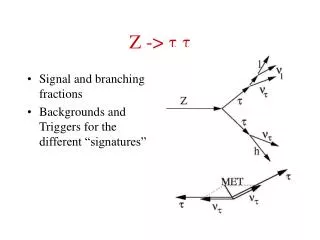
Signal and branching fractions Backgrounds and Triggers for the different “signatures” Z -> t t
Z -> t t -> ... • t t -> th th n n s*b = 82 pb • t t -> th e n n n 39 pb • t t -> th m n n n 39 pb • t t -> m e n n n n 12 pb • t t -> m m n n n n 6.2 pb • t t -> e e n n n n 6.2 pb
Z -> t t -> ee/mm • Background: • Z-> ee , Z-> mm : s*b 30 times higher than for signal • as n in t decays aligned with t no difference in Df • leptons have lower pt for signal (bad…) • invariant mass - mZ • But be aware: g* contribution…
pT electrons > 10 GeV (DIEL trigger) Z -> t t : .5% (.125) 20% of signal Z -> ee : 38% QCD: 0.02%: 1 event (from4528 events with pt>20 GeV) ee inv. mass < 60 GeV: 1% Z -> ee left reinvestigate single e with higher statistic Z -> t t -> ee
pT muons > 4 GeV (DIMUON trigger) Z -> t t : 1.1% (.3% background), 36% Z -> mm: 36% QCD: 9% of events with pt>20 GeV inv. mm mass < 60 GeV: 9% Z -> mm left 0.6% from 800 W mn+fake Z -> t t -> mm
Z -> t t -> e m • s = 12 pb • Physics background: WW-> e m n n (0.2 pb) top top-> b b e m n n • QCD via misidentification (Zee, Zmm,W…) • MU_EM: L1 e > 5 GeV, L2> 10 GeV L1,L2 m > 4 GeV
em: 16% eff 28 events (22 in right category) with projecting the MET back-> Z mass statistics too low for a meaningful plot Z -> t t -> ee/mm/em
Z -> t t -> th lep • Signal s = 39 pb each • Backgrounds: • QCD misidentification • Z(+ jets)-> ll + jets with misid+inefficiency • W(+jets) -> l + misid • WW -> e th n n • th: for now require NN>0.4
Z -> t t -> th lep • Possible triggers (electron case):A) Single electron: e pt>15GeV B) electron+jet: e pt> 10 GeV, jet> 10GeV C) electron+t: e pt>5 GeV (needs track trigger) • Muon case: A) Single m : threshold 7 GeV B) m + jet: m pt > 4 GeV but jet ET>20 GeV C) m + t : m pt > 4 GeV and 5 GeV t
Z -> t t -> th th • Di tau trigger: needs track trigger • requires two tracks > 5 GeV, one with preshower + 2 jets > 3 GeV • difficult to study without trigger simulator...
QCD blue: m red: e black: em Z -> t t -> th lep
Z -> t t - needed: • Working trigger simulator with events that can be processed by it • root-tuples (or at least reco files) of: • Signal Z -> t t about 10k events • QCD files • W->e n, W-> m n, Z->other, same statistics • other backgrounds as top, b, WW
Z -> t t - Conclusions • Only leptonic decays: • expect about 20% efficiency • probably only em mode usable • Leptonic hadronic mode: • efficiencies about 25% (40% without t req) • Only had: need trigger simulator • And overall: need more statistics …