
Understanding Trellis Structures for Forward and Viterbi Algorithms
This document explores the construction and application of trellis structures in the Forward and Viterbi algorithms. It provides detailed step-by-step calculations, showcasing the progression from start to end states using probabilities. Key examples illustrate how to compute the final probabilities at various points, such as transitioning through states and factoring in given probabilities. Both algorithms are critical in the fields of hidden Markov models and sequence analysis, with unique uses in decoding and processing sequences effectively.

Understanding Trellis Structures for Forward and Viterbi Algorithms
E N D
Presentation Transcript
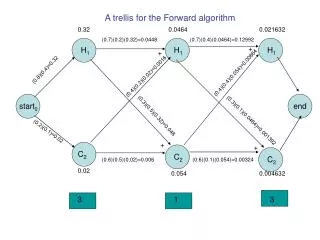
A trellis for the Forward algorithm H1 H1 H1 start0 end C2 C2 C2 3 1 3 0.32 0.0464 0.021632 (0.7)(0.2)(0.32)=0.0448 (0.7)(0.4)(0.0464)=0.12992 + + (0.8)(0.4)=0.32 (0.4)(0.2)(0.02)=0.0016 (0.4)(0.4)(0.054)=0.00864 (0.3)(0.5)(0.32)=0.048 (0.3)(0.1)(0.0464)=0.001392 (0.2)(0.1)=0.02 + + (0.6)(0.5)(0.02)=0.006 (0.6)(0.1)(0.054)=0.00324 0.02 0.054 0.004632
A trellis for the Viterbi algorithm H1 H1 H1 start0 end C2 C2 C2 3 1 3 0.32 0.0448 0.012544 (0.7)(0.4)(0.0448)=0.012544 (0.7)(0.2)(0.32)=0.0448 max max (0.8)(0.4)=0.32 (0.4)(0.4)(0.048)=0.00768 (0.4)(0.2)(0.02)=0.0016 (0.3)(0.5)(0.32)=0.048 (0.3)(0.1)(0.0448)=0.001344 (0.2)(0.1)=0.02 max max (0.6)(0.1)(0.048)=0.00288 (0.6)(0.5)(0.02)=0.006 0.02 0.00288 0.048
