Download

1 / 20
200 likes | 306 Vues
This lesson focuses on the epic poem "Beowulf," diving into its major characters such as Grendel, Grendel’s mother, and the dragon, as well as the tribes of Geats, Danes, and Swedes. Students will investigate the characteristics of an epic hero, the poem's structure, and its themes of heroism, fate, and good vs. evil. Discussions will cover allegorical meanings, especially relating to the battles Beowulf faces. Assignments will enhance comprehension through reading and the exploration of the hero's journey, encouraging collaboration and diverse interpretations.

E N D
Beowulf Week 2
Warm up Aug 30 • Have you completed comprehension questions 1 – 13? If not, do so now. If you have, check your answers with another student. Discuss any answers that are different.
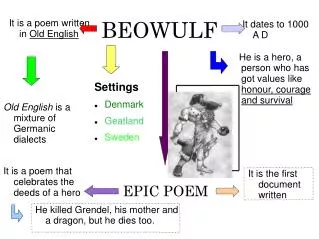
The Who • Who & About Whom • Who are the major characters in the poem? • Poem divided into thirds based on monster • Grendel • Grendel’s mother • Dragon • Also about three tribes • Geats • Danes • Swedes
The Epic Hero • Beowulf is an epic hero. • An epic hero undertakes a quest to achieve something of great value to himself and society.
The What • Epic poem – “long narrative poem that relates the great deeds of a larger-than-life hero who embodies the values of a society”. Includes elements of myth, folklore and history. Tone is serious, language is grand.
Structure of epic poem • Long, narrative poem • Strong rhythm • No rhyme • Alliteration • Kennings • Caesura
The Allegory • Allegory – a story in which characters, settings and events stand for abstract and moral concepts. • What in Beowulf seems unrealistic? How might it be allegorical?
Allegories • Grendel - fratricide • Grendel’s mother – deepest animalistic aggressions • The dragon – Often represented greed
Where • Three archetypal sites of fear (that’s that darn 3 again) • Barricaded night house (Heorot) • Infested underwater cave • Dragon’s lair How are these settings allegorical or symbolic?
Themes • Heroism • Fate • Fame • Good vs Evil • Anglo Saxon code
Homework • Read from line 1251 – line 1708 by Thursday/Friday and complete the comprehension questions for section 2.
Warm up Aug 31/Sep 1 • Fill in the hero’s journey for the section that you have read. • Make sure that you add in as much detail as possible. • Feel free to discuss with a classmate, there is often more than one right interpretation.
Hero Mentor Shadow Herald Threshold Guardian Trickster Shapeshifter Ally Archetypes – now list all the archetypes that you have observed.Who plays which role? Give an example.
Allegory • What does the battle with Grendel represent? • How and what do we learn about Beowulf from this section? • How does this relate to the message of the work?
Listen & Interpret • Seeing as Beowulf is really a piece that is meant to be heard, we are going to listen to Seamus Heaney tell the story. • As he speaks, you will interpret what he says. This could be in the form of: • Notes • Drawings • Mapping etc
Warm up Sep 2 & 3 • Complete, discuss and/or compare comprehension question answers.
Hero’s Journey • Fill in the hero’s journey for the section that you have read. • Make sure that you add in as much detail as possible. • Feel free to discuss with a classmate, there is often more than one right interpretation.
Allegory • What does the battle with Grendel’s mother represent? • How and what do we learn about Beowulf from this section? • How does this relate to the message of the work?
Homework • Read from line 1709 – 2210 for Tues/Wed Sep 6 & 7.