SlideServe
Menu
Préférences
© SlideServe · v2026

Project: IEEE P802.15 Working Group for Wireless Personal Area Networks

bradshawr avatar
6 diapositives · 92 Views · Jan 07, 2020

Contribution to IEEE P802.15 TG3c at September 2005 meeting in Garden Grove regarding amendments to FCC regulations governing unlicensed 57-64 GHz band. WCAI proposes clarifications and exemptions for indoor antennas. Detailed update by Gary Baldwin scheduled for next week's conference call.
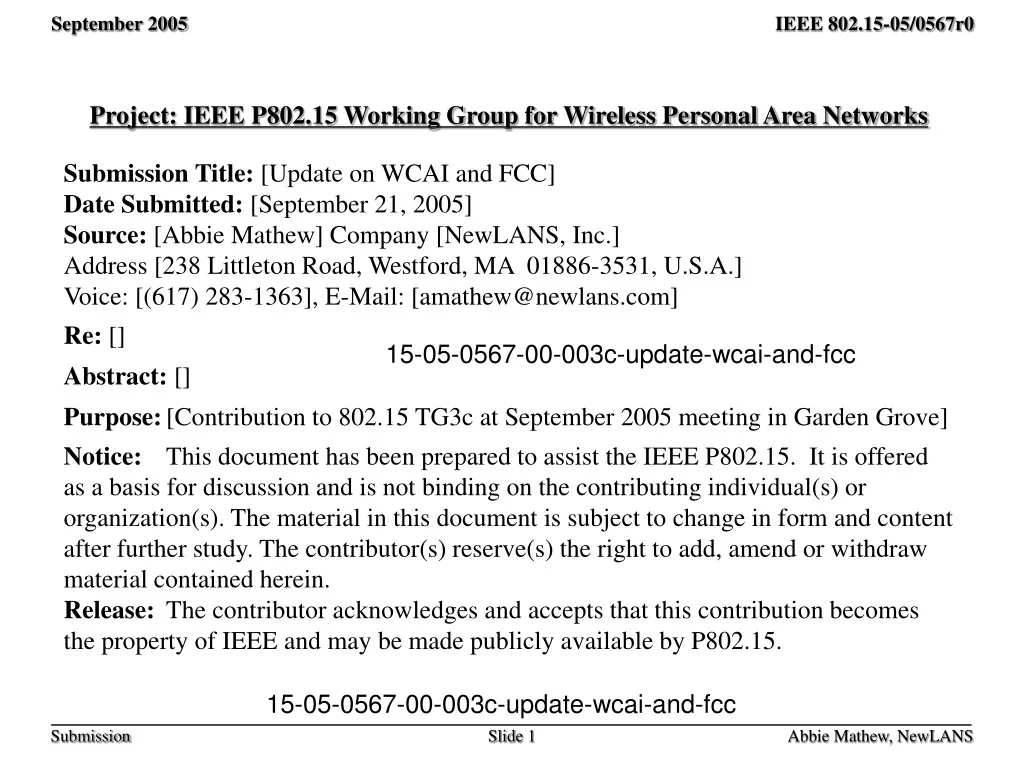
Project: IEEE P802.15 Working Group for Wireless Personal Area Networks - slide 1
01 / 6Project: IEEE P802.15 Working Group for Wireless Personal Area Networks
1 / 17

Télécharger la présentation

Project: IEEE P802.15 Working Group for Wireless Personal Area Networks
Une image / un lien ci-dessous est fourni (tel quel) pour télécharger la présentation

Politique de téléchargement : le contenu du site vous est fourni TEL QUEL pour votre information et votre usage personnel ; il ne peut être vendu, concédé sous licence ni partagé sur d’autres sites sans l’accord de son auteur.Le contenu vous est fourni TEL QUEL, pour votre information et votre usage personnel uniquement. Téléchargez la présentation en cliquant sur ce lien. Lors du téléchargement, si vous ne parvenez pas à télécharger une présentation, l’éditeur a peut-être supprimé le fichier de son serveur.Pendant le téléchargement, si vous ne parvenez pas à obtenir une présentation, le fichier a peut-être été supprimé par l’éditeur.

F I N

Plus de contenu associé

Transcription de la présentation
  1. Project: IEEE P802.15 Working Group for Wireless Personal Area Networks Submission Title: [Update on WCAI and FCC] Date Submitted: [September 21, 2005] Source: [Abbie Mathew] Company [NewLANS, Inc.] Address [238 Littleton Road, Westford, MA 01886-3531, U.S.A.] Voice: [(617) 283-1363], E-Mail: [amathew@newlans.com] Re: [] Abstract: [] Purpose: [Contribution to 802.15 TG3c at September 2005 meeting in Garden Grove] Notice: This document has been prepared to assist the IEEE P802.15. It is offered as a basis for discussion and is not binding on the contributing individual(s) or organization(s). The material in this document is subject to change in form and content after further study. The contributor(s) reserve(s) the right to add, amend or withdraw material contained herein. Release: The contributor acknowledges and accepts that this contribution becomes the property of IEEE and may be made publicly available by P802.15. 15-05-0567-00-003c-update-wcai-and-fcc 15-05-0567-00-003c-update-wcai-and-fcc

  2. Pertinent Documents • 15-05-0054-00-003c-wcas-petition-to-fcc-amendment-to-part-15-255 • 15-05-0111-00-003c-co-existence-60-ghz-window-links-and-indoor-wlan-system • 15-05-0268-00-003c-us-regulatory-items-in-60-ghz.ppt • 15-05-0400-01-003c-comments-wca-petition • 15-05-0417-00-003c-wca-chronology-july05-ppt • 15-05-0432-00-003c-wca-60ghz-proposal-faqs-ppt • 15-05-0433-00-003c-reply-to-comments-on-wca-petition-to-change-fcc-regulations-governing-the-unlicensed-57--64-ghz-band-ppt • 15-05-0442-01-003c-comments-wca-petition-to-change-fcc-regulations-governing-unlicensed-57-64-ghz-band • 15-05-0562-00-003c-ieee-letter-to-fcc-in-response-to-wcais-petition

  3. Existing Rules in Part 15.255 Interference • Average power density ≤ 9 W/cm2 at 3 m • Translates to EIRP of 40 dBm in the far field • Peak power density ≤ 18 W/cm2 at 3 m • Translates to an EIRP of 43 dBm in the far field • Total peak transmitter power ≤ 500 mW RF Radiation • Power density ≤ 1 mW/cm2 on antenna surface Transmitter Identification • Within any 1 second interval of signal transmission, each transmitter must transmit a transmitter identification at least one

  4. WCAI’s Case # 1 “..the near field for a high gain antenna typically extends beyond the 3-meter point, so there is little correlation between 3-meter PD measurements and the level of RF exposure near the antenna..” WCAI’s Suggestion EIRP = 82 dBm for Gain > 51 dBi EIRP = [(2 * Gain) – 20] dBm for Gain ≤ 51 dBi

  5. WCAI’s Case # 2 “…which imposes a transmitter identification (ID) requirement on indoor antennas used at 57-64 GHz. The purpose of the rule is to permit users experiencing interference from indoor wireless LAN transmitters to more accurately identify where the interference is coming from. The rule thus applies to the transmitter ID requirement to transmission that emanate from inside a building. Unfortunately, there remains some confusion over whether the rule’s exclusion of outdoor antennas also excludes antennas located indoors but directed outside a window, commonly referred to as ‘window links.’ WCA believes it is reasonable to assume that the Commission did not intend to apply the rule to window links, since they effectively pose no greater interference risk than outdoor links.” WCAI’s Suggestion “…WCA therefore asks that the Commission eliminate any lingering uncertainty about this issue by modifying Section 15.255(i) to clarify that the rule’s transmitter ID requirement does not apply to indoor antennas that direct point-to-point transmissions outside through a window.”

  6. Next Step Gary Baldwin to give detailed update next week at the channel model conference call • Dial-in number: +(641) 985-8000 • Access code: 657719# • Time • EST (US) 8 PM, Tuesday, September 27 • PST (US) 5 PM, Tuesday, September 27