Understanding Instantaneous Velocity and Acceleration in AP Physics C
This resource explores the concepts of instantaneous velocity and acceleration using limits and derivatives in AP Physics C. With examples including position functions and polynomial derivatives, students can learn to calculate acceleration at specific time intervals. Using the velocity function ( v = -t^2 + 2 ), the instantaneous acceleration at ( t = 0.4 ) seconds is determined to be ( -8 , text{m/s}^2 ). Additionally, exercises for various functions help solidify understanding through practical applications, preparing students for advanced physics challenges.

Understanding Instantaneous Velocity and Acceleration in AP Physics C
E N D
Presentation Transcript
Using the Derivative AP Physics C Mrs. Coyle http://www.ima.umn.edu/~arnold/graphics.html
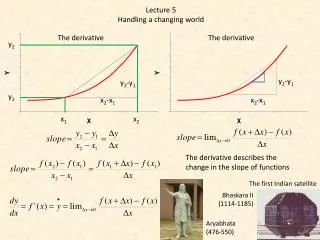
Instantaneous Velocity v = limDx Dt0Dt or v = dx dt
Instantaneous Acceleration a = limDv Dt0Dt or a = dv dt
Using the limit to calculate instantaneous acceleration. • Example 1: The velocity of a particle is given by v= -t2 + 2 (t is in sec). Find the instantaneous acceleration at t= 4s (using the limit). Answer: -8 m/s
Evaluating the derivative of a polynomial. For y(x) = axn dy = a n xn-1 dx -Apply to each term of the polynomial. -Note that the derivative of constant is 0.
Using the derivative to calculate instantaneous acceleration. • Example 2: The velocity of a particle is given by v= -t2 + 2 (t is in sec). Find the instantaneous acceleration at t= 4s (using the derivative). Answer: -8 m/s
Example 3: A particle’s position is given by the expression x= 4-t2 + 2t3 (t is in sec). Find for t= 5s : • Its position • Its velocity • Its acceleration Answer: a) 229m, b) 140 m/s, c) 58 m/s2
Example 4 An object follows the equation of motion x= 3t2 -10t +5. • At what time(s) is its position equal to zero? • At what time is its velocity equal to zero? Hint: Remember for a quadratic equation ax² + bx + c = 0 , the roots are: Answer: a) 0.62sec and 2.7sec, b) 1.7sec