Nathaniel Hawthorne: A Journey Through Early Life and Influential Works
Nathaniel Hawthorne, born on July 4, 1808, in Salem, Massachusetts, was a significant American writer known for his contributions to dark romanticism. He was the great-great-grandson of John Hathorne, a judge in the Salem Witch Trials. Despite early struggles in his career, including the anonymous publication of "Fanshawe," he gained recognition with classics like "The Scarlet Letter" and "The House of the Seven Gables." Inspired by Puritan themes, his works combined historical romance with deep psychological symbolism. His friendships with literary figures like Emerson and Melville shaped his legacy.

Nathaniel Hawthorne: A Journey Through Early Life and Influential Works
E N D
Presentation Transcript
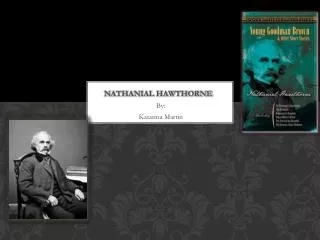
Nathanial Hawthorne By: Katarina Martin
Early Life: • Born July 4th 1808, in Salem Mass. • his great-great-grandfather, John Hathorne, was one of the judges who oversaw the Salem Witch Trials. • Nathaniel later added a "w" to make his name "Hawthorne". • - In the summer off 1816 he lived with farmers as boarders in Maine, until a house was built just for him and his family in. • - In 1819, he was sent back to Salem to go to school.
Early Life count. • In spite of his homesickness, for fun, he distributed to his family seven issues of The Spectator in August and September 1820. • - Homemade newspaper was written by hand and included essays, poems, and news utilizing the young author's developing adolescent humor.
Early Career: • Hawthorne served as the editor of the American Magazine of Useful and Entertaining Knowledge in 1836. • He contributed short stories, including "Young Goodman Brown" and "The Minister's Black Veil", to various magazines and annuals, though none drew major attention to the author. • He contributed short stories, including "Young Goodman Brown" and "The Minister's Black Veil", to various magazines and annuals, though none drew major attention to the author.
Writing Styles and Themes: • He mostly wrote short stories and poems. • He did romanticism or, more specifically, dark romanticism. • Many of his works were inspired by Puritans. • -He combined historical romance with symbolism and deep psychological themes, bordering on surrealism.
Novels: • Only wrote a few: • - Fanshawe (published anonymously) • - The Scarlet Letter • - The House of the Seven Gables • - The Marble Faun: Or, The Romance of Monte Beni
Short Stories: • - Roger Malvin'sBurial • - My Kinsman, Major Molineux • - Young Goodman Brown • - The Ambitious Guest • - The Minister's Black Veil • - The Maypole of Merry Mount • - Dr. Heidegger's Experiment
The MayPole of Merry Mount • - The people of Merrymount, whom Hawthorne calls the "crew of Comus," celebrate the marriage of Edgar and Edith, a youth and a maiden. • - They dance around a maypole and are described as resembling forest creatures. They are interrupted by the arrival of John Endicott and his Puritan followers. • - Endicott orders for the people of Merrymount to be whipped. Stricken by the newlyweds, he spares them but orders they be put in more conservative clothing. • - He also orders the youth cut his hair in the "pumpkin shell“ style to show how strict the Puritans are.
Interesting Facts: • - Hawthorne was a friend with a number of Transcendentalists, including Emerson and Thoreau, though he never fully embraced their views. But that didn’t create any bad blood. Emerson was a pallbearer at Hawthorne’s funeral. • - Herman Melville dedicated his great novel Moby Dick to Hawthorne, his good friend. • - When he presented his manuscript for The Scarlet Letter to the publisher, they deemed it too short for publication. • - Hawthorn struggled with the idea of being a writer, since many of his relations didn't consider it "real" work.