Download
1 / 5
50 likes | 243 Vues
This guide explains the rules of gender and number agreement for Spanish adjectives. It emphasizes that adjectives must match the nouns they modify in both number and gender. Singular nouns require singular adjectives, while plural nouns require plural adjectives. Special cases include adjectives ending in -o, which have four forms, and those that change depending on whether the noun is masculine or feminine. Examples include "bonita" (feminine singular) and "bonitas" (feminine plural), along with common adjectives like "bajo" and "alta."

E N D
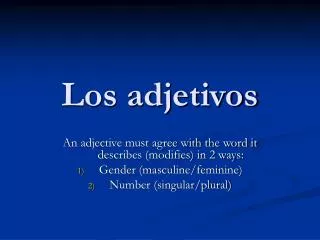
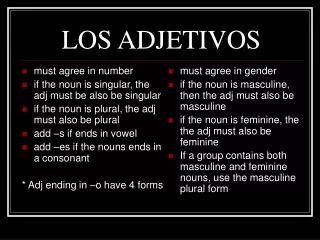
must agree in number if the noun is singular, the adj must be also be singular if the noun is plural, the adj must also be plural add –s if ends in vowel add –es if the nouns ends in a consonant * Adj ending in –o have 4 forms must agree in gender if the noun is masculine, then the adj must also be masculine if the noun is feminine, the the adj must also be feminine If a group contains both masculine and feminine nouns, use the masculine plural form LOS ADJETIVOS
bonita bonitas delgado delgados intelectual intelectuales alta altas feo feos simpático simpáticos LAS RESPUESTAS
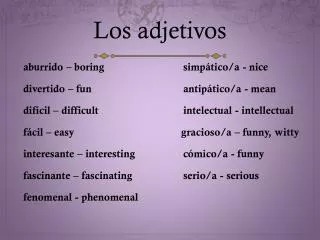
bajo bajos moreno morenos rubia rubias serio serios aburrido aburridos antipático antipáticos LOS ADJETIVOS
gorda gordas tonto tontos pelirrojo pelirrojos tímida tímidas guapa guapas extrovertido extrovertidos LOS ADJETIVOS