Enhancing SDN with OpenFlow & Packet Processing Pipeline
Discover how OpenFlow protocol revolutionizes Software Defined Networks, separating control and data plane, enabling programmability, and implementing flow tables for efficient packet processing. Explore proposed schemes for hash-based classification and Bloom filters in enhancing network performance.

Enhancing SDN with OpenFlow & Packet Processing Pipeline
E N D
Presentation Transcript
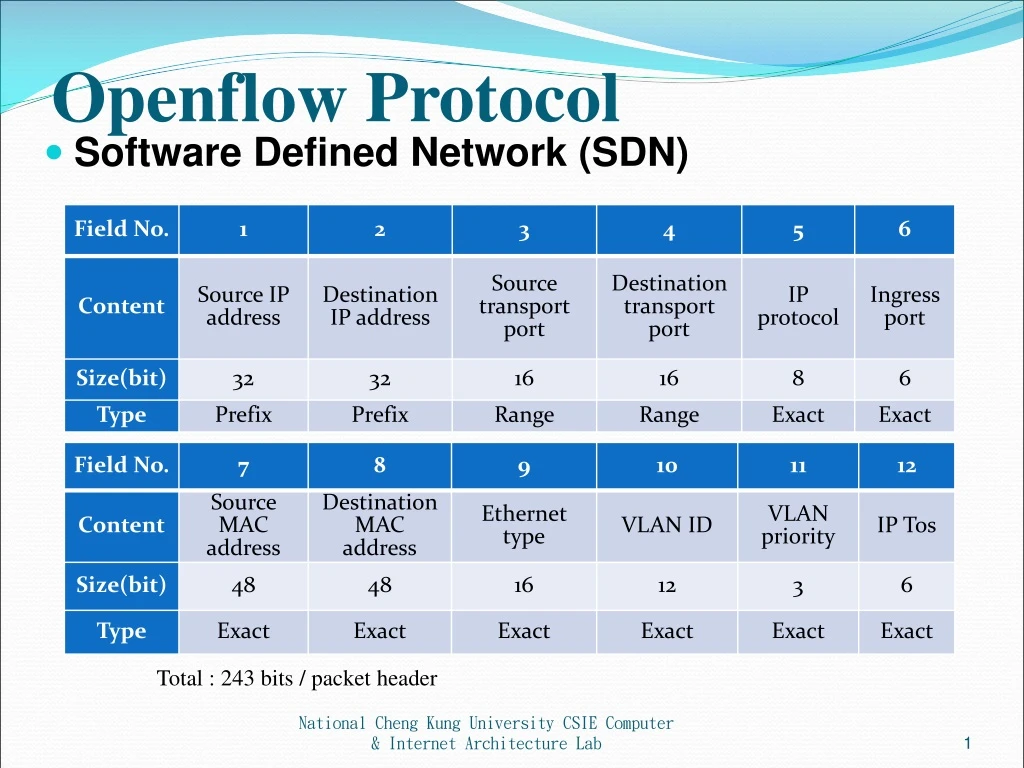
Openflow Protocol • Software Defined Network (SDN) Total : 243 bits / packet header National Cheng Kung University CSIE Computer & Internet Architecture Lab
Drawbacks of Traditional Network • Difficult to perform real world experiments on large scale production networks. • Usage of custom ASICs with vendor specific software leads to innovation and configuration problems. National Cheng Kung University CSIE Computer & Internet Architecture Lab
Software Defined Network • Decouples the control plane and data plane. • Program a network instead of configure a network. National Cheng Kung University CSIE Computer & Internet Architecture Lab
OpenFlow Overview • Stanford Nick McKeown proposed a way for researchers to run experimental protocols in networks they use every day • OpenFlow is a protocol which enables programmability of the data/forwarding plane. • OpenFlow specification describes the requirements of an OpenFlow Logical Switch. • OpenFlow specification also specifies a list of OpenFlow messages/API. National Cheng Kung University CSIE Computer & Internet Architecture Lab
OpenFlow Controller • Manages one or more switch via OpenFlow channels. • OpenFlow protocol to communicate with OpenFlow switch. • Provides a network wide abstraction for the applications on north bound. • Responsible for programming various tables in OpenFlow switch. • OpenSource controllers: ONOS (JAVA) OpenDayLight (JAVA) Floodlight (JAVA) RYU (Python) NOX/POX (Python) Control-plane Data-plane Data-plane Data-plane National Cheng Kung University CSIE Computer & Internet Architecture Lab
OpenFlowAware Switch • OpenFlow 1.1 introduces multi table and group table support. • OpenFlow 1.3 introduces meter table support. • Up to 1.5.1 National Cheng Kung University CSIE Computer & Internet Architecture Lab
Packet Processing Pipeline National Cheng Kung University CSIE Computer & Internet Architecture Lab
Flow Table • Aflow table consists of flow entries: • Match fields specifies which packet headers are used to match against. OpenFlow 1.0 supports 12match fields, while OpenFlow 1.3/1.4/1.5 supports up to 40/41/44 match fields. • Priority describes the rule precedence. • Counters field is used to count packets/bytes that match the entry. • Instructions are executed when a packet matches the entry. Instructions contain either a set of actions to add to the action set, contains a list of actions to apply immediately to the packet, or modifies pipeline processing. • Timeouts specify the liveness time of a entry. Eth type Switch Port IP Src IP Dst IP Prot L4 sport L4 dport IP ToS MAC src MAC dst VLAN pcp VLAN ID National Cheng Kung University CSIE Computer & Internet Architecture Lab
Reactive Forwarding Scheme Controller Flow_Mod Packet_Out Flow_Mod Packet_Out Flow_Mod Packet_Out IP=10.0.0.2 IP=10.0.0.1 Packet_In Packet_In Packet_In packet packet packet packet H1 Switch1 Switch2 Switch3 H2 1 2 1 3 2 1 National Cheng Kung University CSIE Computer & Internet Architecture Lab
Hash-based OpenFlow Packet Classification onHeterogeneous System Architecture(在異質性系統架構上之以Hash為基礎的OpenFlow封包分類) • Single hash table can not process the macroflow rules. • Linear Search in the macroflow tables is very slow. • Binary Range Tree and Binary Trie are not efficient for the fields eith only exact values. National Cheng Kung University CSIE Computer & Internet Architecture Lab
Proposed scheme • We proposed a hash-based and decision-tree based scheme to process the fields those contain exact value • This scheme can be used as an accelerator for traditional packet classification method. National Cheng Kung University CSIE Computer & Internet Architecture Lab
Proposed scheme – Overview National Cheng Kung University CSIE Computer & Internet Architecture Lab
Bloom Filter • Used to check an element is in a set or not. • High space efficiency and constant lookup time. • May has false positive matches, but does not have false negatives. • Hash function 1: F(k) = k mod 16 F(34) = 2 • Hash function 2: F' (k) = (k/11) mod 16 F'(34) = 1 Bloom filter (16 bits) 0110 0011 0101 1010 • If updateis needed, use Counting Bloom Filter National Cheng Kung University CSIE Computer & Internet Architecture Lab
Cuckoo Hashing • h(k ) = • h’(k) = Computer & Internet Architecture Lab CSIE, National Cheng Kung University
Cuckoo Hashing Insert Example 3 3 20 20 20 20 20 20 20 100 100 67 20 20 67 67 67 100 67 100 39 36 3 36 3 53 53 53 50 53 50 50 50 53 53 50 50 105 50 50 105 50 39 105 50 50 105 75 67 75 75 75 53 53 75 53 20 53 75 53 53 Computer & Internet Architecture Lab CSIE, National Cheng Kung University 20 105 20 75 75 75 100 100 100 100 100
Proposed scheme – L1 Hash Table National Cheng Kung University CSIE Computer & Internet Architecture Lab
Proposed scheme – L2 Hash Table National Cheng Kung University CSIE Computer & Internet Architecture Lab
Proposed scheme – L3 Hash Table National Cheng Kung University CSIE Computer & Internet Architecture Lab
Proposed scheme – Bloom filter phase (1/5) • In the Bloom filter phase of L1, it contains a 128bits Main bloom filter, 2 possibility bitmaps and a 4bits ignoring flag. • In the Bloom filter phase of L2 node, it contains a 64bits Main bloom filter, 2 possibility bitmaps and 8bits ignoring flag. National Cheng Kung University CSIE Computer & Internet Architecture Lab
Bloom Filter phase Input filed 11, 12 of header Proposed scheme – Bloom filter phase(2/5) miss Main Bloom Filter Hit in bloom filter Possibility Bitmap Get possibility bitmap Ignoring Flag Merge with ignoring flag Get a result without merging possibility bitmap Get a bitmap result Continue to hash table phase National Cheng Kung University CSIE Computer & Internet Architecture Lab
Proposed scheme – Bloom filter phase (3/5) National Cheng Kung University CSIE Computer & Internet Architecture Lab
Proposed scheme – Bloom filter phase (4/5) Main Bloom filter • Use 2 hash functions • Result of hash function 1 = 2 • Result of hash function 2 = 7 National Cheng Kung University CSIE Computer & Internet Architecture Lab
Proposed scheme – Bloom filter phase (5/5) Possibility bitmap x 2 • Result of hash function 1 = 2 • Result of hash function 2 = 7 • Merge 2 bitmaps using OR operation • (1011) OR (1100) = 1000 • Means only table 0 need to be search National Cheng Kung University CSIE Computer & Internet Architecture Lab
Proposed scheme –Insert into Hash Table L1 Hash table L2 Hash table L3 Hash table • Rule ID = 50 • L1 Hash Code = 2 • L2 Hash Code = 6 • L3 Hash Code = 4 National Cheng Kung University CSIE Computer & Internet Architecture Lab
Proposed scheme –Search inHash Table L1 Hash table L2 Hash table L3 Hash table Get result Rule ID = 4792 • L1 Hash Code = 4 • L2 Hash Code = 7 • L3 Hash Code = 4 National Cheng Kung University CSIE Computer & Internet Architecture Lab
Proposed scheme – Compression Bitmap Base Array National Cheng Kung University CSIE Computer & Internet Architecture Lab
Proposed scheme – Cache and Microflow National Cheng Kung University CSIE Computer & Internet Architecture Lab
Proposed scheme – Optimize National Cheng Kung University CSIE Computer & Internet Architecture Lab
Outline • Introduction • Related Work • Proposed Schemes • Experimental Result • Conclusion National Cheng Kung University CSIE Computer & Internet Architecture Lab
Experiment Result - Environment Platform 1 Platform 2 National Cheng Kung University CSIE Computer & Internet Architecture Lab
Experiment Result – Rule Set (1/2) • We use FRuGto generate two rule sets. • One ruleset contains only one type of rule, contains no wildcard (*), the size is 50K • Another one ruleset contains 127 types of rules, contains wildcards (*), the size is 12K. • All the parameter of generator is set as default. National Cheng Kung University CSIE Computer & Internet Architecture Lab
Experiment Result – Rule Set (2/2) National Cheng Kung University CSIE Computer & Internet Architecture Lab
Experiment Result – Throughput National Cheng Kung University CSIE Computer & Internet Architecture Lab
Experiment Result – Memory Consumption National Cheng Kung University CSIE Computer & Internet Architecture Lab
Experiment Result – Comparing (1/3) National Cheng Kung University CSIE Computer & Internet Architecture Lab
Experiment Result – Comparing (2/3) National Cheng Kung University CSIE Computer & Internet Architecture Lab
Experiment Result – Comparing (3/3) National Cheng Kung University CSIE Computer & Internet Architecture Lab
Conclusion • In this thesis, we proposed a high throughput, low cost and low power consumption scheme, it can achieve high throughput on APU platform. • The throughput of our scheme can achieve 1836MPPS, and achieve 1983 MPPS with cache. • The memory consumption is 38 MB. • The power consumption of whole platform is about 115 watts. National Cheng Kung University CSIE Computer & Internet Architecture Lab
Thanks for Your Attention National Cheng Kung University CSIE Computer & Internet Architecture Lab