Exploring the Diverse World of Fungi: Types, Functions, and Reproduction
Fungi are fascinating organisms that play vital roles in ecosystems as heterotrophs, absorbing nutrients through powerful enzymes. With various types, including chytrids, zygote fungi, glomeromycetes, and more, they exhibit unique reproductive strategies involving spores and mycelium structures. Some, like mushrooms and truffles, are edible, while others can be poisonous. Additionally, lichens, a symbiosis of fungi with algae or cyanobacteria, thrive in diverse habitats. This exploration delves into the complexity of fungi, their ecosystems, and their importance in our lives.

Exploring the Diverse World of Fungi: Types, Functions, and Reproduction
E N D
Presentation Transcript
Fungi • Mushrooms, mold, lichens • Stationary • Heterotrophs – absorption • Secrete powerful enzymes that digest their food outside of their body and absorb nutrients • Asexual or Sexual Reproduce by spores
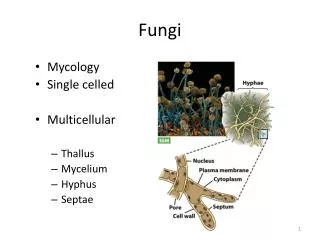
Hyphae • Threadlike structure • Covered by a cell wall of chitin • Nuclei, cytoplasm, mitochondria, and ribosomes • Create a mycelium
Chytrids • Only fungi with flagellated spores • Earliest lineage of fungus • Common in lakes, ponds, and soil
Zygote Fungi • Hyphae from two different organisms mate and fuse to from a zygote • Form through meiosis • Have Stolons and Rhizoids • Bread mold, mold on peaches, strawberries, sweet potatoes
Glomeromycetes • Arbuscular mycorrhizal fungi • Hyphae will invade plant roots and branch into tiny tree like structures (arbuscules)
Club Fungi • Possess club shaped structures: basidia • Mushrooms, shelf fungi, rusts, puff balls
Edible Poisonous
Sac Fungi • Possess a sac like structure: ascos • Live in marine, freshwater, or terresrial habitats • Truffles, yeast, cap fungi, mildew
Cup Fungi Yeast
Lichens • Composed of a fungus and green algae or cyanobacteria • Grows in soil, rock, and trees • Autotrophic • Photosynthetic
Mycosis • Fungal infection