Master Power Sentences in 6 Weeks: Lesson 1
In this engaging lesson, students will learn to write high-quality power sentences by understanding and applying four key rules. They'll explore the essential components of a sentence, including nouns, verbs, adjectives, adverbs, and similes. Through guided practice and interactive check-ins, students will enhance their writing skills, building confidence and creativity. By the end of the lesson, each student will have crafted their own power sentence, demonstrating their mastery of sentence structure. Join us to ignite a passion for writing!

Master Power Sentences in 6 Weeks: Lesson 1
E N D
Presentation Transcript
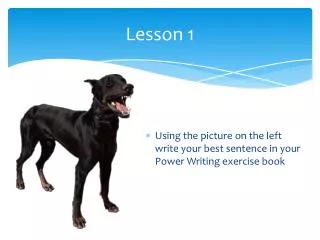
Lesson 1 Using the picture on the left write your best sentence in your Power Writing exercise book
Power Sentence Writing Learn to write at a Year 5-6 level in only 6 weeks!
Lesson 1 Learning Objective To understand and apply the 4 rules to writing Power Sentences Success Criteria Every student will complete a high quality power sentence by the end of the lesson.
Class Rules Introducing “CFU” No hands questioning Check-in for feedback
APK (Activate Prior Knowledge) What do you use at the start of a sentence? A capital letter is used to start a sentence.
APK (Activate Prior Knowledge) What do you use at the end of a sentence? A full stop, question mark or exclamation mark is used to end a sentence.
APK (Activate Prior Knowledge) What is a noun? A noun is a person, place or thing.
APK (Activate Prior Knowledge) What is a verb? A verb is a doing word.
APK (Activate Prior Knowledge) What is an adjective? An adjective is a word that describes a noun.
APK (Activate Prior Knowledge) What is an adverb? An adverb is a word that describes a verb.
APK (Activate Prior Knowledge) What is a simile? A phrase that uses the words like or as to describe someone or something.
CFU The dog walked towards me. Identify the noun and write it on your Whiteboard.
CFU The dog walked towards me. Identify the verb and write it on your Whiteboard.
Brainstorm Write an adjective that describes the dog.
Brainstorm Write an Adverb that describes the way the dog is walking towards you.
The 4 Rules Apply a time connective (Where appropriate) Add 1-2 adjectives Add 1 Adverb Add a simile (Extension)
The Learning Process I do We do You do
I do Step 1: Add a time connective It was a cold winter afternoon, the dog walked towards me. The dog walked towards me.
I do Step 2: Add 1-2 Adjectives It was a cold winter afternoon, the big, menacing dog walked towards me. It was a cold winter afternoon, the dog walked towards me.
I do Step 3: Add an Adverb It was a cold winter afternoon, the big, menacing dog walked slowly towards me. It was a cold winter afternoon, the big, menacing, dog walked towards me.
I do Step 4: Add a simile It was a cold winter afternoon, the big, menacing dog walked slowly towards me like a puma hunting his prey. It was a cold winter afternoon, the big, menacing dog walked slowly towards me.
Check-in It was a cold winter afternoon, the big, menacing dog walked slowly towards me like a puma hunting his prey. The dog walked towards me.
We do Rules • Add a time connective • Add 1-2 Adjectives • Add 1 adverb • Add a simile The dog walked towards me.
You do Rules • Add a time connective • Add 1-2 Adjectives • Add 1 adverb • Add a simile The dog walked towards me.
Plough back Rules • Add a time connective • Add 1-2 Adjectives • Add 1 adverb • Add a simile
Lesson 1 Check-in Learning Objective To understand and apply the 4 rules to writing Power Sentences Success Criteria Every student will complete a high quality power sentence by the end of the lesson.