Understanding Process Switching and Inter-Process Communication in UNIX Systems
This comprehensive overview delves into the mechanisms of process switching in UNIX, highlighting kernel stack, page tables, and how the kernel manages execution states during transitions between processes. Moreover, it examines inter-process communication (IPC) methods such as message passing and shared memory, emphasizing synchronization techniques. The discussion also contrasts threads with processes, including user-level and kernel-level threads, their management, advantages, and synchronization challenges. This guide serves as a valuable resource for understanding the core concepts of process orchestration in UNIX operating systems.

Understanding Process Switching and Inter-Process Communication in UNIX Systems
E N D
Presentation Transcript
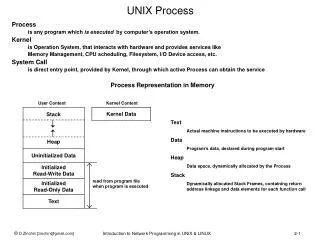
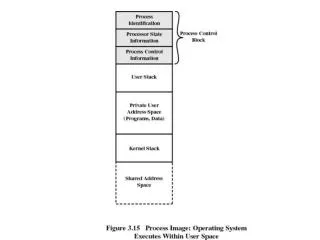
Process switching in UNIX • each process has a kernel stack which is accessible only to the kernel but is part of the process image • each process has a page table which maps both its memory image and the kernel memory image • when switching mode from user to kernel, process switches to its kernel stack but doesn’t change the page table
Process switching in UNIX (cont’d) • the execution state of the old process is saved on its kernel stack • the kernel switches from the old address space to the address space of the process scheduled to run next • the execution state of the new process to run is restored from its kernel stack
Inter-process communication • most OSs provide several abstractions for inter-process communication: message passing , shared memory, etc.. • communication requires synchronization between processes (i.e. data must be produced before it is consumed) • synchronization can be implicit (message passing) or must be explicit (shared memory) • explicit synchronization can be provided by the OS (semaphores, monitors, etc..) or can be achieved exclusively in user-mode (if processes share memory)
Message passing • protected communication between different address spaces send (destination, message) receive(source, message) • synchronization on send: • asynchronous (non-blocking send) • blocking send until the message “is sent” • blocking send until the message is received • synchronization on receive: • asynchronous (non-blocking receive) • blocking receive until message arrives
Message passing (cont’d) • message addressing • direct: specify the process • indirect: specify the queue • mutual exclusion using messages • non-blocking send • blocking receive
Message passing implementation kernel buffers kernel 1st copy process 1 2nd copy x=1 send(process2, &X) X process 2 receive(process1,&Y) print Y Y • two copy operations in a conventional implementation
Shared memory implementation kernel shared region process 1 X=1 X process 2 physical memory print Y Y • no copying but synchronization is necessary
Threads, SMP, and Microkernels Chapter 4
Threads • the process concept incorporates two abstractions: a virtual processor (an execution context) and a resource ownership (an address space, opened files etc..) • within an address space we can have more units of execution: threads • all the threads of a process share the same address space and the same resources
Multithreaded environment • Process • a virtual address space that holds the process image • all resources allocated: IPC channels, files etc.. • Threads • an execution state: running, ready, etc.. • an execution context: PC, SP, other registers • a per-thread stack
Threads vs. Processes • operations on threads (creation, termination, scheduling, etc..) are cheaper than the corresponding operations on processes • inter-thread communication is supported through shared memory without kernel intervention • advantages • disadvantages • easy to introduce race conditions • synchronization is necessary
Posix thread (Pthread) API • thread creation and termination pthread_create(&tid,NULL,start_fn,arg); pthread_exit(status)’ • thread join pthread_join(tid, &status); • mutual exclusion pthread_mutex_lock(&lock); pthread_mutex_unlock(&lock); • condition variable pthread_cond_wait(&c,&lock); pthread_cond_signal(&c);
Condition variables (example) • thread 1 pthread_mutex_lock(&lock); while (!my-condition); pthread_cond_wait(&c,&lock); do_critical_section(); pthread_mutex_unlock(&lock); • thread 2 pthread_mutex_lock(&lock); my-condition = true; pthread_mutex_unlock(&lock); pthread_cond_signal(&c);
Process • Have a virtual address space which holds the process image • Protected access to processors, other processes, files, and I/O resources
Thread • An execution state (running, ready, etc.) • Saved thread context when not running • Has an execution stack • Some per-thread static storage for local variables • Access to the memory and resources of its process • all threads of a process share this
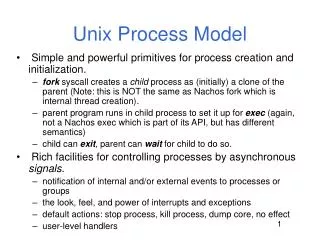
User-Level Threads • All thread management is done by the application • The kernel is not aware of the existence of threads
Kernel-Level Threads • Kernel maintains context information for the process and the threads • Scheduling is done on a thread basis
Thread implementation • user-level threads • implemented as a thread library which contains the code for thread creation, termination, scheduling and switching • kernel sees one process and it is unaware of its thread activity • can be preemptive or not (coroutines) • kernel-level threads (lightweight processes) • thread management done by the kernel
User-level vs. kernel-level threads • advantages of user-level threads • performance: low-cost thread operations (do not require crossing protection domains) • flexibility: scheduling can be application specific • portability: user-level thread library easy to port • disadvantages of user-level threads • if a user-level thread is blocked in the kernel, the entire process (all threads of that process) are blocked • cannot take advantage of multiprocessing (the kernel assigns one process to only one processor)
User-level vs.kernel-level threads (cont’d) kernel-level threads user-level threads thread scheduling user kernel process thread scheduling process scheduling processor processor
Thread/process operation latencies processes user-level threads kernel-level threads Operation 11,300 usec 948 usec 34 usec null fork signal-wait 37 usec 441 usec 1,840 usec
User-level thread implementation kernel process pc thread 1 pc sp thread 2 sp thread stacks




![[Unix Programming] Process Basic](https://cdn2.slideserve.com/4450358/unix-programming-process-basic-dt.jpg)