The Evolution of Immigration in Italy: From Emigration to Influx
Over the past century, Italy has transformed from a nation of emigration, with over 20 million Italians leaving during the "Big Migration" or "Italian Diaspora", to a significant host country for immigrants. Since 1973, the dynamics of immigration have shifted, with Italy experiencing an influx of over 101 immigrants for every 100 emigrants. The fall of the Soviet Union in the early 1990s marked a pivotal moment, leading to the arrival of migrants from Eastern Europe and later from North Africa during the Arab Spring. Today, Italy remains a vital crossroads for migration in Europe.
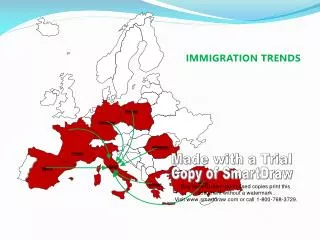

The Evolution of Immigration in Italy: From Emigration to Influx
E N D
Presentation Transcript
IMMIGRATION The roleof Italy in Europeanmigrations
During the 100 years after the birth of the Italian republic , more than 20 million people emigrated from our country. Today this massive migration is called the “Big Migration” or the “Italian Diaspora”. During this period immigration was almost an inexistent process. • But nowdays things are changed…
The rise of immigration • Onlyfrom 1973 in Italy can beregistered a major numberofimmigrants: 101 immigrants - 100 emigrants, characteristicthatwouldhave spread in the followingyears. • Departingfrom 1979 Italy will start toregister more and more foreignimmigrants. • With the “open doorspolitic” Italy will face with massive migration, startingfrom the “falling” of the SovieticUnion
First Massive Immigration • In 1991, Italy faced the first massive migrationfromcountriesthatbelongedto the URSS, suchasPoland or Romania, butexpeciallyfrom Albania. Accordingto Caritas’ datas, Italy was hosting almost 994.000 migrantsthatyear. • Then, becauseof North Africanrevolutions (knownasArabSpring), Italy facedfrom 2010 to 2012 anenormousmigrationfrom Libia, Egypt and Tunisia
Nextgraphics show the migrationflowscomparedwith the numberofinhabitants in eachof the showncountries and the percentageofforeigncitizenspopulation
MadeBy • GIANMARCO LOSI