The Electromagnetic Spectrum
This document provides a comprehensive overview of the electromagnetic spectrum, detailing various frequency ranges from radio waves (5×10^19 Hz), including their applications in fields such as space communication and radio astronomy. It discusses significant phenomena such as the Cosmic Microwave Background Radiation, molecular rotations in microwave ovens, and the harmful effects of ultraviolet radiation in the atmosphere. The role of different types of radiation in understanding star and gas distribution is also examined, making this a valuable resource for students and enthusiasts in physics.

The Electromagnetic Spectrum
E N D
Presentation Transcript
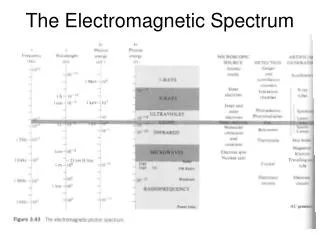
The Electromagnetic Spectrum PHYSICS 1 • Somnath Bharadwaj and Pratik Khastgir, Department of Physics and Meteorology, IIT Kharagpur, 721 302 India http://www.cts.iitkgp.ernet.in/~phy1/
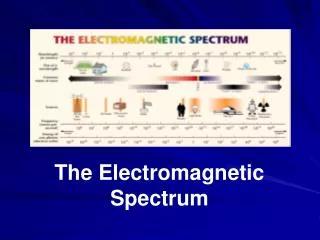
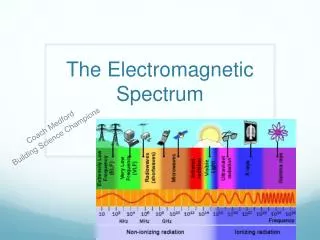
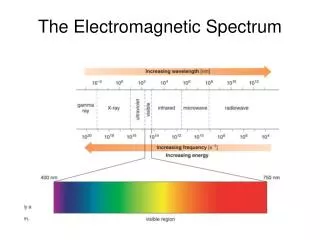
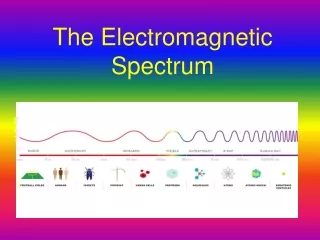
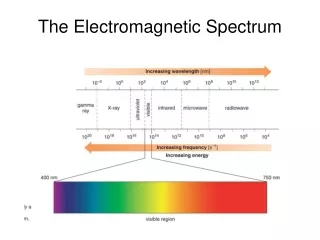
Radio wave Less than 1 GHz
Microwave 1 GHz to 3 1011 Hz 30 cm to 1 mm
Space communication Atmosphere is transparent from less than 1 cm to 30 m Also suitable for radio astronomy
Radio Interferometric Arrays 32 MHz bands with 128 separate channels
HI in Galaxies DDO 210 Source: Begum and Chengalur Dwarf Irregular Galaxy
Cosmic Microwave Background Radiation T=2.73 K CMBR
Molecular Rotations Water 2.45 GHz used in microwave ovens Excites Rotations of water molecules 50 GHz to 10 THz T-rays
Infrared 3 1011 Hz to 4 1014 Hz Near IR 760 - 3000 nm Intermediate IR 3000 - 6000 nm Far IR 6000 - 15000 nm Extreme IR 15000nm – 1 mm Human body peaks at 10000 nm
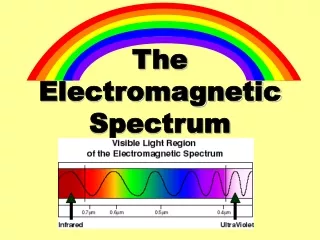
Visible Light 3.84 1014 Hz to 7.69 1014 Hz Mainly atomic transitions – outer levels Hot bodies ~5000K
Ultraviolet 8 1014 Hz to 3 1016 Hz Enough energy to ionize atoms in upper atmosphere Is harmful – absorbed by O3 in upper atmosphere Produced in energetic atomic transitions
X-ray 2.4 1016 Hz to 5 1019 Hz Energetic electrons incident on a metal Hot astrophysical sources – Black Holes Inner shell transitions in atoms
Centaurus Cluster Credit: J. Sanders, A. Fabian,
Gamma Rays Frequency greater than 5 1019 Hz Produced in nuclear transitions Electron-positron annihilation Easy to detect – ionizes gas