Exploring Viruses and Bacteria: Life, Classification, and Disease
This comprehensive overview delves into the complex world of viruses and bacteria, exploring their classifications and differences. While viruses are debated to be "alive," they depend on hosts for reproduction and possess genetic material. In contrast, bacteria are classified as living organisms with various shapes and reproduction methods. The text discusses the lytic and lysogenic cycles of viruses, the role of vaccines in disease prevention, and the impact of antibiotic resistance in bacteria. Various diseases caused by each are highlighted, emphasizing the significance of understanding these microorganisms.

Exploring Viruses and Bacteria: Life, Classification, and Disease
E N D
Presentation Transcript
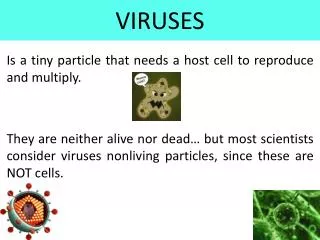
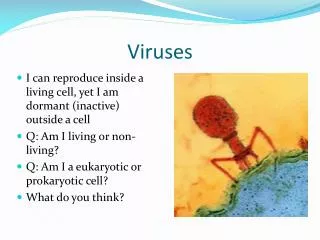
Alive or not? • Although some scientists disagree, viruses are classified as NOT ALIVE • What do you think? • They CANNOT reproduce without a host • They are NOT made of cells • They DO contain DNA or RNA • They CAN evolve
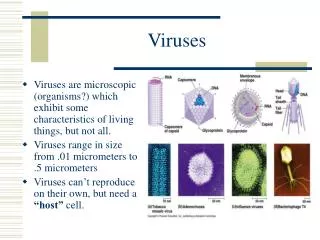
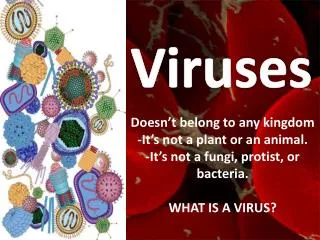
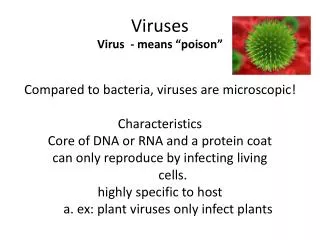
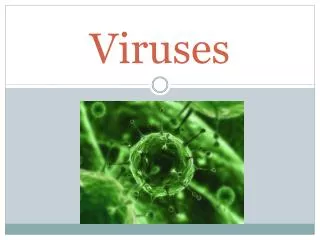
What is a virus? - It is a particle of made up of nucleic acid, protein and sometimes lipids that can replicate only by infecting living cells
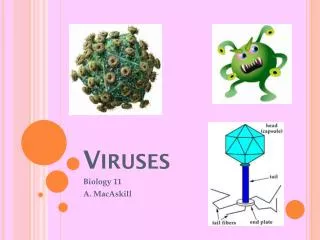
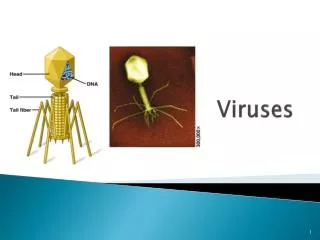
Virus Structure • Draw this and label it!
Lytic Cycle (infection) • Animation: http://pgl.ufl.edu/modules/mysterious_invaders/lytic.htm
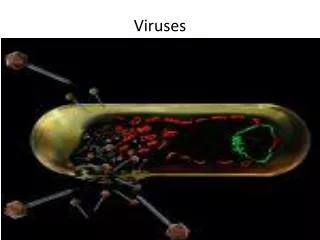
Lytic Cycle • In the lytic cycle, new viruses are produced in the host cell until it bursts (lyses)
Lysogenic Cycle • Animation: http://pgl.ufl.edu/modules/mysterious_invaders/lytic.htm
Lysogenic Cycle • In the lysogenic cycle, the viral DNA is incorporated into the host cell DNA and can stay dormant for years
Vaccines • Viruses can only be prevented with vaccines, they cannot be destroyed with antibiotics • Vaccines are weakened, altered, or blank forms of the virus that cause your immune system to create antibodies • This way if you ever come into contact with the real virus, you already have built up resistance
Diseases • Some diseases caused by viruses are: • The Flu (influenza) • Common Colds • HIV (causes AIDS) • West Nile • Chicken Pox • Herpes • Hepatitis • HPV (genital warts) • Measles • Polio • Smallpox • SARS • Mononucleosis • Ebola
Classification • Unlike viruses, bacteria ARE alive • Bacteria are prokaryotic, and they make up two domains, Bacteria and Archaea
Characteristics • Bacteria live everywhere on earth! • Some bacteria have flagella, which makes them able to move, some cannot move • Some require oxygen to live, some do not • Some are heterotrophic (chemoheterotrophs and photoheterotrophs) and some are autotrophic (chemoautotrophs and photoautotrophs)
Bacteria Shape • Bacteria come in 3 shapes: • Rod, Bacilli • Sphere, Cocci • Spiral, Spirilla
Reproduction • Bacteria can reproduce 2 ways: • Asexually by binary fission: • Sexually by conjugation:
Pros and Cons • What are the benefits to an organism that reproduces sexually? Asexually? • What are some problems associates with reproducing sexually? Asexually?
Bacterial Diseases • Here are some human diseases caused by bacteria: • Tetanus • Lyme Disease • Tuberculosis • Meningitis • Flesh-eating Bacteria • Strep Throat • Whooping Cough • Plague • Syphillus • Leprosy • Anthrax • Gonorrhea • Salmonella
Antibiotics • Bacteria diseases can be cured by antibiotics • The first antibiotic, penicillin, was discovered by accident by Alexander Fleming in 1928 • Penicillin is actually a mold that forms holes in the bacteria’s cell walls • However, bacteria are quickly evolving to become antibiotic resistant • We can no longer fight all bacteria diseases with antibiotics
Antibiotic Resistance • Based on what you know about natural selection, how do bacteria evolve to become drug-resistant when we only take half of our prescription?