
Examining sin2θW with DIS-Parity at JLab 12 GeV
E N D
Presentation Transcript
DIS-Parity: Measuring sin2θW with Parity Violation in Deep Inelastic Scattering using Baseline Spectrometers at JLab 12 GeV Paul E. Reimer
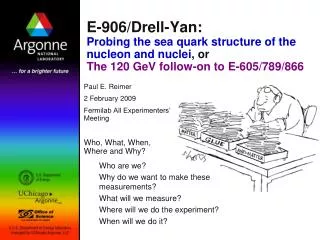
Charge • Standard Model parameters: • Charge, e ,aem • g , GF m lifetime Vector: giV= t3L(i) – 2qi sin2(qW) Axial: giA = t3L(i) • MZ • sin2(qW) Weak isospin Weinberg-Salam model and sin2(qW) • Unification of Weak and E&M Force • SU(2)—weak isospin—Triplet of gauge bosons • U(1)—weak hypercharge—Single gauge boson • Electroweak Lagrangian: • Jm, JmYisospin and hypercharge currents • g, g0 couplings between currents and fields Gary Larson, The Far Side Remember—I’m not the expert here.
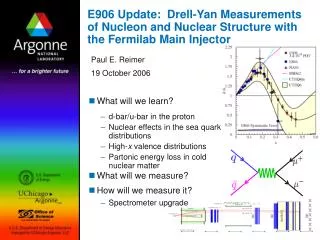
Running of sin2(W) • Measurements of sin2(W) • APV Cs • Møller Scattering (SLAC E-158) • DIS (NuTeV) • Clear indication of running of sin2(W) • Future Experiments • Q-Weak (JLab) • Møller (JLab 12 GeV) • DIS-Parity at JLab 12 GeV
e e DIS Formalism on unpolarized Deuterium Target Longitudinally polarized electrons on unpolarized deuterium target—Cahn and Gilman, PRD 17 1313 (1978). C1q) NC vector coupling to q £ NC axial coupling to e C2q) NC axial coupling to q £ NC vector coupling to e Cia provide sensitivity to sin2(qW) Note that each of the Cia are sensitive to different possible S.M. extensions.
Gain factor of 2 in dsin2(qW) over dAd Large asymmetry Q2 = 3.7 GeV2, Ad = 0.0003 “Easy experiment” e e e e e e + ? g Z APV ~ Sensitivity to sin2(qW) Look for interference between large photon term and New Physics
Q-Weak (JLab) Møller Scattering Atomic Parity Violation e g e e e e e e Z Z g g Cs133 Z g e p e • Coherent quarks in Proton • Results in ~2008 • 2(2C1u+C1d) • S Page Z • Purely Leptonic—no quark interactions • K Kumar/D. Mack n • Coherent quarks in entire nucleus • Nuclear structure uncertainties • -376 C1u – 422 C1d • A. Derevianko and Other talks n n n m Z W + How does DIS-Parity fit in? Neutrino Scattering DIS-Parity Expt. Probe different parts of Lagrangian • Quark scattering (from nucleus) • Weak charged and neutral current difference • Tim Londergan • Isoscaler quark scattering • (2C1u-C1d)+Y(2C2u-C2d) • X Zheng/P. Souder
Jefferson Lab at 12 GeV Upgrade • Upgrade (Completion date?): • 12 GeV (11 GeV to Hall A, B, C) • Addition of Hall D • 85mA to Hall A, C • Currently: • 6 GeV CW beam • 3 exp. Halls (A, B, C) • 80% polarized beam Figures from JLab web site
Criteria for DIS-Parity with baseline equipment Expt. Assumptions: • 60 cm liquid deuterium target • 11 GeV beam @ 90mA • 85% polarization § 0.5% • Rates which can be handled: • 1MHz DIS • /e ¼ 1 ) 1 MHz pions • 2 MHz Total rate General Experimental Criteria: • DIS regime: • Maximize Q2 (3.0-4.0 GeV2) • Large W2 ( > 4GeV2) • Minimize uncertainty from parton distributions: • Deuterium target (d/u ratio vs nuclear effects) • x<0.7 • Maximize sensitivity to sin2W • Large Y Implementation • /e separation ) gas Cherenkov counters ¼ 6 GeV thresh. • Rate requires flash ADC’s or Scaler-based DAQ on Cherenkov and Calorimeters—this is a counting experiment!!
Hall C at 11 GeV • HMS spectrometer • Pmax¼ 7.4 GeV/c §10% • W = 8.1 msr • SHMS spectrometer: • Design in progress • Pmax¼ 11 GeV § 10% • = 5.2 msr SHMS HMS Figures from Hall C CDR
JLab Hall C SHMS/HMS combination Statistical Precision • Two independent spectrometer measurements • Combined statistical precision • A/A = 0.5% • sin2W/sin2W = 0.26% What about Hall A? • Smaller solid angle and lower E0 • Ready for 11 GeV years sooner! What about systematics? • Large asymmetry (3£ 10-4) implies short runtime • 13 “perfect” days • E0 = 7 GeV (scattered electron momentum) • = 13o General experimental criteria are met.
Uncertainties in Ad • Beam Polarization: • Q-Weak also needs 1% polarization accuracy. • Hall C Møller has achieved 0.5% polarization accuracy at low intensity • Determination of Q2 significant • Higher Twist will be studied by • PV-DIS at 6 GeV • Res-Parity
Expected sin2(qW) Results (JLab) dAd/Ad = §0.50% (stat) §0.58% (syst) (§ 0.78% combined) dsin2(qW)/sin2W= § 0.26% (stat) § 0.36% (sys) (§ 0.45% combined) What about Ciq’s?
Extracted Signal—It’s all in the binning Fit Asymmetry data as fn. of Y A = A0 [ (2C1u – C1d) + Y(2C2u – C2d)] intercept = 2C1u – C1d (QWeak)slope = 2C2u – C2d
Exp. Constraints on C1u, C1d, C2u and C2d Present experimental constraints are wide open, except for APV (1 standard deviation limits shown) Combined result significantly constrains 2C2u–C2d. PDG 2C2u–C2d = –0.08 § 0.24Combined d(2C2u–C2d) = § 0.014
DIS-Parity: Conclusions • Measurements of sin2(qW) below MZ provide strict tests of the Standard Model. • DIS-Parity provides complementary sensitivity to other measurements. • DIS-Parity Violation measurements can be carried out in at Jefferson Lab • Asymmetry is Large! Jefferson Lab: d sin2(qW) = 0.0011 d(2C2u – C2d) = 0.014 Waiting for 12 GeV upgrade!