Understanding Momentum: The Key to Stopping Moving Objects
This lesson explores momentum, a vital concept in physics that measures how hard it is to stop a moving object. By calculating momentum using the equation p = mv (momentum = mass × velocity), we can determine which objects are hardest to stop. This is illustrated through examples, including a bullet, a bowling ball, and other moving objects with varying masses and velocities. We also discuss the Law of Conservation of Momentum, which states that the total momentum of a system remains constant unless acted upon by an external force.

Understanding Momentum: The Key to Stopping Moving Objects
E N D
Presentation Transcript
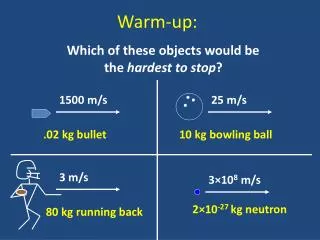
Warm-up: 1500 m/s 25 m/s .02 kg bullet 10 kg bowling ball Which of these objects would be the hardest to stop? 3 m/s 3×10⁸ m/s 2×10-27kg neutron 80 kg running back
Momentum We have learned that inertia determines how difficult it is to change an object’s state of motion, but there is more to the story. We must also consider the velocity of the object. Momentum – a measure of how hard it is to stop a moving object.
Momentum Calculating momentum: Momentum = mass × velocity Equation: p = mv • Units of momentum are (kg)(m)/s • Note that when an object is standing still (v=0), it has no momentum.
Momentum Use p = mv to calculate the momentum of each of the objects from the Warm-up problem. Which one really is the hardest to stop?
Warm-up QOTD: 1500 m/s 25 m/s .02 kg bullet 10 kg bowling ball Which of these objects would be the hardest to stop? 3 m/s 3×10⁸ m/s 2×10-27kg neutron 80 kg running back
Conservation of Momentum The Law of Conservation of Momentum: The total momentum of any system of objects cannot be changed unless an external force is applied to the system. Mathematically: Total momentum before = Total momentum after