Download
1 / 1
10 likes | 144 Vues
This study explores the innovative use of tumbleweed-inspired rovers to navigate the challenging terrains of Mars, specifically the geologically rich region of Dao Vallis. The research leverages a dynamic model of individual tumbleweed rovers in a stochastic simulation, showcasing how these rovers, driven by wind forces, can autonomously disperse over extensive distances. This approach addresses the logistical challenges of accessing remote geological sites by minimizing control systems, thus enhancing Mars exploration efficiency.

E N D
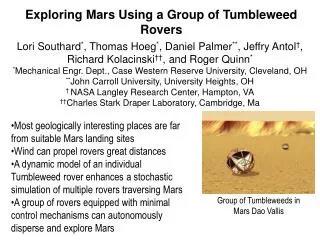
Group of Tumbleweeds in Mars Dao Vallis Exploring Mars Using a Group of Tumbleweed Rovers Lori Southard*, Thomas Hoeg*, Daniel Palmer**, Jeffry Antol†, Richard Kolacinski††, and Roger Quinn**Mechanical Engr. Dept., Case Western Reserve University, Cleveland, OH **John Carroll University, University Heights, OH † NASA Langley Research Center, Hampton, VA ††Charles Stark Draper Laboratory, Cambridge, Ma • Most geologically interesting places are far from suitable Mars landing sites • Wind can propel rovers great distances • A dynamic model of an individual Tumbleweed rover enhances a stochastic simulation of multiple rovers traversing Mars • A group of rovers equipped with minimal control mechanisms can autonomously disperse and explore Mars