The Early Middle Ages
350 likes | 593 Vues
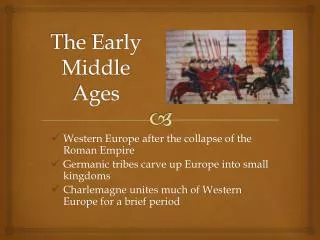
The Early Middle Ages. Germanic Kingdoms. Note: NOT Germans Different kind of civilization: No written laws. No cities. Governed by custom. Elected kings. Nobility swore allegiance to kings. Kings protected all in times of war. War occurred often. Battle of Tours, 732 AD.


The Early Middle Ages
E N D
Presentation Transcript
Germanic Kingdoms • Note: NOT Germans • Different kind of civilization: • No written laws. • No cities. • Governed by custom. • Elected kings. • Nobility swore allegiance to kings. • Kings protected all in times of war. • War occurred often.
Battle of Tours, 732 AD • Franks vs. the Muslims • Charles Martel • Christian victory – God on their side • Muslims keep most of Spain
Charlemagne • Charles the Great (742?-814) • King of Franks (768-814) • Holy Roman Emperor (800-814) • Shared Frankish kingdom with brother until he died • Conquered and Christianized neighboring kingdoms • Northern Italy, part of Spain, all of France, Germany, Low Countries • Restored Pope Leo III and was named “Holy Roman Emperor” on Christma in 800 • Capital at Aachen • Advances in scholarship, literature, law • Called “Carolingian Dynasty”
Christian Emperor • After the fall of the Roman Empire, power was split in two • In the east, a Byzantine emperor ruled in Constantinople • In the west, Rome was frequently invaded by “barbarians”
Christian Emperor • In 800, Charlemagne is named Holy Roman Emperor (HRE) • Emperor in Constantinople considers this as wrong • Charlemagne tries to marry his daughter • Revival of “Roman” Empire in west • Established a feudal system • Issued legal decrees like Romans • Great diplomat with foreign rulers • Except with Muslims in Spain • Protected Christian shrines in Palestine (Jerusalem) • Stabilized the currency (denier) • Trade & commerce vigorous • Used & protected Jewish merchants • Refused to trade iron broadswords with Vikings
Christian Emperor • Palace school • Literacy necessary to be a good Christian • Texts were all corrupt • Learning will lead to better grasp of the truth - Bible • Sacramentary was required • Unified book of prayers & rites for sacraments of church
Tried to make a united Christian Empire • Constantinople upset – thought they were the “true Roman emperor” • Spread Christianity • Nobles to rule locally • “second Rome” at Aachen • Curriculum: Formal course of study • Grammar, Rhetoric, logic, arithmetic, geometry, music and astronomy
Europe after Charlemagne • Died in 814 • Empire fell apart • Many invasions – Muslims, Magyars, Vikings, others…. • Treaty of Verdun • Charlemagne’s grandson’s divide empire into 3
Legacy of Charlemagne • Extended Christianity to northern Europe. • Blended German, Roman, and Christian traditions. • Good strong system of government. • Set a good example for other European rulers. • Strong connection to the Roman Catholic Church.
1347 Bubonic Plague 1066 C.E. Norman invasion of Britain 450 C.E. Anglo-Saxons invade England 1455 C.E. Printing Press 1306-1321 Dante’s Divine Comedy 1386 C.E. Chaucer begins writing Canterbury Tales 306 C.E. Constantine comes to power in Eastern Roman Empire; beginning of Byzantine Empire Beowulf Composed sometime between 476 C.E. Fall of Rome 1453 Fall of Byzantine Empire with invasion of Ottoman Turks 850 C.E. 900 C.E. Middle Ages: General Timeline 1095-1291C.E. Crusades
Feudalism • Obligations • Governmental system • Hierarchy • Lord • Vassel earned a fief • Peasants
Why would people agree to this? • PROTECTION FROM INVADERS!
Knights • Mounted warrior • Age 7 • Training • Dubbing Ceremony • Tournaments
Code of Chivalry • Brave • Valiant • Loyal • True to word • Had to fight fairly • Women were to be revered
Time for a little simulation • You will be given “money” and a role. • DO NOT EAT YOUR MONEY!!!
Women in Medieval Society • Played active roles in society. • Women took over when men left. • Eleanor of Aquitaine was Queen of France and England. • Still, women were daughters of Eve • Weak and easily led to sin • Needed help & guidance of men
The Manor • The Lord’s estate • Village + surrounding lands • Peasants (serfs) – responsible to the lord, paid the lord for various services. • In exchange, the lords gave the peasants their own land to farm and protection.
Why stand for being a serf? • Protection • Land • Guaranteed food, shelter, land, housing, some safety.
The manor included… • Cobbler • Tools • Church • Peasant homes (mud huts) • Mill • Church • Manor House • Blacksmith
Medieval Peasants • Harsh life • No education • Tireless work • Little food • One-room huts • Disease common • Short life-span (35!) • Never-ending work
Foods of Middle Ages • Castle cooks prepared large amounts of food for people • Meat had to be salted or smoked or just kept alive before it was needed • Sometimes meat was pounded to a paste and served as custard.
Table settings • Food served out of trenchers • Plate made out of bread • People often had to bring their own utensils (mostly ate with hands) • Shared cups and sometimes trenchers
Clothing • Peasants probably had one change of clothing – maybe two • A lot of wool clothing • Outer clothing not washed but under clothing washed often • Many peasants died from exposure in winter
Childhood • Many women and children died in childbirth • Everyone was needed in fields so babies often left alone or with older children while parents worked. • Began working and doing chores around age 7 • Boys educated as apprentices
Marriage • Men usually older than women • Girls sometimes married at age 12 • Usually arranged marriages • Men had total control over women • “Rule of thumb?” • Men could divorce women for many reasons
Medicine • People believed diseases were spread by bad odors • Diseases were caused by sins of the soul • Medical remedies often caused more harm • Blood letting
Games • Chess • Dice • Bowling • Checkers • Backgammon