
Understanding the German Verb "würden": Conjugation and Usage
The German verb "würden" corresponds to the English "would" and is a special form of "werden." It is primarily employed to express wishes, hypothetical scenarios, or polite requests. Conjugated as "ich würde," "du würdest," "er/sie/es würde," "wir würden," "ihr würdet," "sie/sie würden," it is imperative to place the main verb in its infinitive form at the end of the sentence. Examples include: "Was würdest du sagen?" (What would you say?) and "Würdest du bitte lauter sprechen?" (Would you please speak louder?).

Understanding the German Verb "würden": Conjugation and Usage
E N D
Presentation Transcript
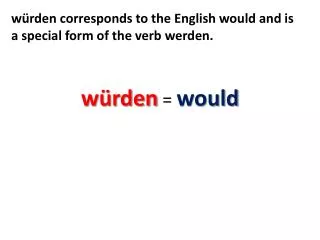
würden corresponds to the English would and is a special form of the verb werden. würden = would
Let’s look at the conjugations of the verb würden. würde Ich Du Er/sie/es Wir Ihr Sie/sie würdest würden is considered the general subjunctive (Konjunktiv II). It is used to express a wish or a hypothetical conclusion würde würden würdet würden
The construction würde + infinitive is sometimes called the "conditional" and is equivalent to the English would + infinitive. When you use würden, the other verb is placed at the end of the sentence in it’s infinitive form. 1) What would you say? Was würdest dusagen? 2) He would not go with us. Erwürdenichtmitunsgehen. 3) How would you do that? Wiewürdest du das machen? 4) She would not take the car. Siewürde das Auto nichtnehmen.
Uses of würden 1) For making hypothetical Conclusions…. IchwürdemeineFreundevermissen. I would miss my friends. 2) For expressing polite requests….. Würdest du bittelautersprechen? Would you please speak louder? 3) For making wishes…. (normally using wenn –if) Wenn du nurmitmirkommenwürdest. If you would only come with me.