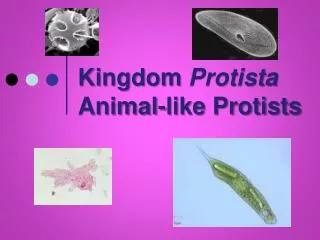
Kingdom Protista Animal-like Protists
420 likes | 843 Vues
Kingdom Protista Animal-like Protists. Introduction. Protozoa (the animal-like protists) are the most abundant organisms in the world in terms of numbers and biomass Protozoa are also called zooplanton. Introduction. Their principle importance is as consumers of bacteria


Kingdom Protista Animal-like Protists
E N D
Presentation Transcript
Introduction • Protozoa (the animal-like protists) are the most abundant organisms in the world in terms of numbers and biomass • Protozoa are also called zooplanton
Introduction • Their principle importance is as consumers of bacteria • They are also often sources of food. For example, baleen whales live on nothing but small protists (zooplankton and phytoplankton)
Introduction • They are also important as parasites and symbionts of multicellular animals
Introduction • They are defined as single-celled, aquatic, eukaryotic organisms that exhibit diverse motility mechanisms
Introduction • Protozoa may be heterotrophic or autotrophic
Phylum Sarcodina • Example: Amoeba
Sarcodina: Characteristics • Blobby shape • Cytoplasm has ectoplasm & endoplasm • Pseudopodia • Change shape all the time • Contractile vacuole
Sarcodina: Movement • Cytoplasmic streaming • Pseudopodia
Sarcodina: Nutrition/Food • Heterotrophic • Eat Bacteria, organic debris, other protists
Sarcodina: Response/Senstivity • Move away from light— Called an avoidance reaction (They will dehydrate quickly if they stay in light)
Sarcodina: Reproduction • Divide asexually by mitosis
Sarcodina: Environment/Economic Importance • Recyclers • 1st or 2nd consumer in the aquatic food chains • Cause disease (dysentery) • Eat bacteria
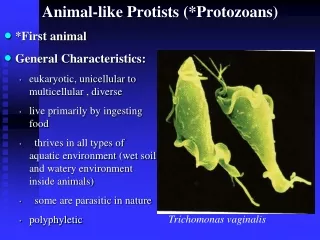
Phylum: Zoomastogina Examples: Leishmania Trichomonas
Phylum: Zoomastogina • Movement: 1 to 4 whip-like flagella • Nutrition/Feeding: Bacteria; other protists; organic debris
Phylum: Zoomastogina • Response/Sensitivity: None Known • Reproduction/Life Cycle: Asexual by mitosis
Phylum: Zoomastogina Environmental/Economic Importance: • Many are disease-causing
Phylum: Zoomastogina Diagram
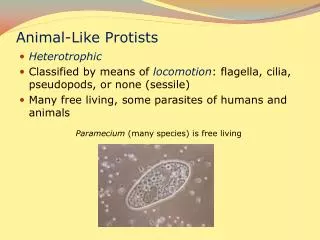
Phylum Ciliophora • Examples: Paramecium
Ciliophora: Unique Characteristics • Cilia all over or in distinct regions • 2 nuclei • Contractile vacuole to control water balance Paramecium Humor
Ciliophora: Movement • Rhythmic beating of cilia causes somersaults or rotating motions
Ciliophora: Nutrition/Food • All heterotrophic • Eat Bacteria, organic debris, other protists • Cilia sweep food particles into oral groove; food enters mouth pore and makes a food vacuole
Ciliophora: Response/Sensitivity • Avoidance Reaction • respond to light, chemicals, and/or temperature changes • Trichocysts for defense—harpoon-like for stinging
Ciliophora: Reproduction/Life Cycle • Asexual by mitosis • Sexual—recombination of DNA by conjugation (see details in your book)
Ciliophora: Environmental/ Economic Importance • Recyclers of nutrients • Cleaners • 1st or 2nd consumers in aquatic food chains
Phylum: Sporozoa • Examples: Plasmodium (causes malaria)
Sporozoa: Unique Characteristics • All parasitic • All disease-causing
Sporozoa: Movement • None • “Go with the flow” • Move with blood or saliva of host organism
Sporozoa: Nutrition/Food • Feed on blood of Host • Heterotrophic
Sporozoa: Response/Sensitivity • None—nothing needed since it is parasitic and is always inside of a host organism.
Sporozoa: Reproduction/Life Cycle • Complex Life cycle involving 2 or more hosts • 2 part life cycle • 1 part sexual • 1 part asexual
Sporozoa: Environmental/ Economic Importance • Diseases are expensive to cure and prevent • “Idol Gives Back” buys mosquito netting to help poor areas where malaria exists
Sporozoa-Diagram • No diagram because they are too small to see in detail, even with an electron microscope • Instead, be familiar with the life cycle (see diagram in your note sheet; use your book or last slide to fill in blanks)
Sporozoa Here is a picture of malaria infected blood cells.
Sporozoa--life cycle of Plasmodium, the causative agent of malaria