Comprehensive Overview of Memory Management Techniques and Disk Management in Operating Systems
This guide provides an in-depth exploration of memory management concepts including address binding, execution time, dynamic loading, swapping, and various allocation methods. It covers single and multiple partition allocation, basic schemes, and advanced techniques such as paging and segmentation. Readers will learn about virtual memory, demand paging, page replacement algorithms (FIFO, LRU, and more), and the management of secondary storage. Further, it examines disk structure, free-space management, and allocation methods to ensure efficient disk scheduling and overall optimal performance of the operating system.

Comprehensive Overview of Memory Management Techniques and Disk Management in Operating Systems
E N D
Presentation Transcript
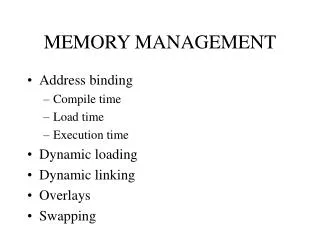
MEMORY MANAGEMENT • Address binding • Compile time • Load time • Execution time • Dynamic loading • Dynamic linking • Overlays • Swapping
MEMORY MANAGEMENT (cont.) • Single-Partition Allocation • Multiple-Partition Allocation • Basic scheme • Long-Term Scheduling • Compaction • Multiple Base Registers • Paging
MEMORY MANAGEMENT (cont.) • Segmentation • Implementation • Protection and Sharing • Paged Segmentation • VIRTUAL MEMORY • Demand Paging • Performance • Page Replacement
VIRTUAL MEMORY (cont.) • Page-Replacement Algorithms • FIFO • Optimal • LRU • Counters • Stack • Second Chance, LFU, MFU, and Ad-hoc. • Allocation of Frames
Secondary Storage Management • Disk Structure • Free-Space Management • Allocation Methods • Contiguous • Linked • Indexed • Disk Scheduling • Storage Hierarchy
Disk Management • The operating system is responsible for the following activities in connection with disk management: • Freespace management • Storage allocation • Disk scheduling