Mastering the Half-Reaction Method for Balancing Redox Reactions
This guide provides a comprehensive approach to balancing redox reactions using the half-reaction method. It begins with a simple example of silver and iron reaction and progresses to more complex reactions involving permanganate and iron ions. The method highlights the importance of separating reactions into oxidation and reduction half-reactions, balancing atoms and charges, and adding electrons to ensure both halves are equal. Two practical examples encourage practice, allowing students to master the technique with ease.

Mastering the Half-Reaction Method for Balancing Redox Reactions
E N D
Presentation Transcript
Pg 646 - 651 Balancing redox reactions
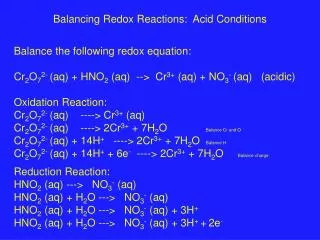
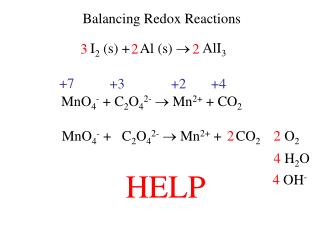
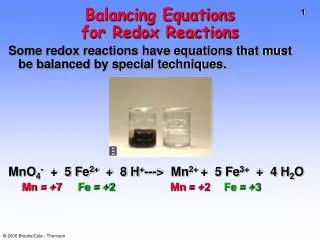
Balancing Redox Reaction • Can use “old” way: Ag (s) + Fe(NO3)3 (aq) Fe (s) + AgNO3 (aq) • But what if we have a reaction that looks like this…. MnO4- (aq) + Fe2+ (aq) Fe3+ (aq) + Mn2+ (aq) acid
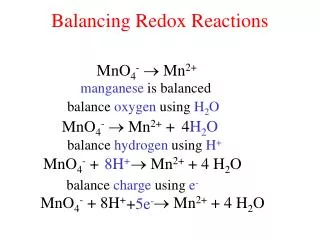
Half-Reaction Method • Separate the reaction into an oxidation half-reaction and a reduction half-reaction. • Balance ANY atom that isn’t an H or O in each reaction using coefficients.
Half-Reaction Method • Balance any O’s by adding water to the opposite side of the half-reaction. • Balance any H’s by adding H+ to the opposite side of the reaction.
Half-Reaction Method • Add electrons to each half-reaction so that the charges on both sides of the reaction are the same. • Balance the total number of electrons so they are EQUAL in both reactions.
Half-Reaction Method • Add the two half-reactions together • Check to make sure the atoms and charges balance!!
Let’s try one more!! • Balance the following redox reaction using the half-reaction method: Pb (s) + PbO2 (s) + H+ (aq) Pb2+ (aq) + H2O (l)
Now you try one!! Balance the following reaction using the half-reaction method: Ni (s) + NO3- (aq) Ni2+ (aq) + NO2 (g)