Understanding Mass Defect and Binding Energy in Nuclear Reactions
160 likes | 298 Vues
In this class, we explore the concepts of mass defect and binding energy within nuclear physics. Students will rank atomic particles based on their mass and apply these concepts through calculations, starting with the example of copper-63. We'll learn to find mass defects and binding energies, addressing questions like the mass defect of an alpha particle and its implications in nuclear reactions. Engage in practical exercises to deepen your understanding, preparing for upcoming challenges in nuclear equations and decay sequences.


Understanding Mass Defect and Binding Energy in Nuclear Reactions
E N D
Presentation Transcript
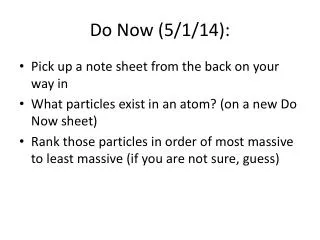
Do Now (5/1/14): • Pick up a note sheet from the back on your way in • What particles exist in an atom? (on a new Do Now sheet) • Rank those particles in order of most massive to least massive (if you are not sure, guess)
Mass Defect: • The difference between the sum of the mass of the individual nucleon (proton or neutron) and the actual mass.
Example: • Find the mass defect of a copper-63 nucleus if the actual mass of a copper-63 nucleus is 62.91367 amu Find the composition of the copper-63 nucleus and determine the combined mass of its components. Copper has 29 protons and copper-63 also has (63 - 29) 34 neutrons. The mass of a proton is 1.00728 amu and a neutron is 1.00867 amu. The combined mass is calculated: 29 protons(1.00728 amu/proton) + 34 neutrons(1.00867 amu/neutron) or 63.50590 amu
Example: • Find the mass defect of a copper-63 nucleus if the actual mass of a copper-63 nucleus is 62.91367 amu • Calculate the mass defect. • Dm = 63.50590 amu - 62.91367 amu = 0.59223 amu
Binding Energy • The energy equivalent of the mass defect; it is always negative • It is the minimum amount of energy needed to break the nucleus into its component nucleons.
Binding Energy of Alpha Particle For the alpha particle Δm= 0.0304 u which gives a binding energy of 28.3 MeV
It Takes a Lot More Energy to Split a Nucleus Than to Ionize an Atom
Practice:Work on the Mass Defect worksheet.Finish all mass defect and binding energy problems by the end of class for extra credit!
Do Now (5/2/14): • What is the mass defect of an alpha particle if its mass is 4.00153u? • What is the binding energy of an alpha particle?
Decay Sequence Alpha decay sequence: 235 U 92 4 231 He + Th 2 90 209 Po 84 4 205 He + Pb 2 82
Decay Sequence Beta decay sequence: 14 C 6 14 0 N + e 7 -1 228 Ra 88 228 0 Ac + e 89 -1
Practice: • Use the rest of class to work on “Mass Defect and Binding Energy” and “Nuclear Reactions.”