Understanding Matter and Its Changes: Properties, States, and Chemical Reactions
This comprehensive overview covers the essential concepts of matter, including its definition as anything with mass that occupies space. It distinguishes between physical and chemical changes and properties, detailing examples like freezing, melting, and rusting. Key terms such as density, melting point, freezing point, and solubility are defined to enhance understanding. Additionally, it explains the four states of matter and emphasizes the law of conservation of mass. This guide serves as a foundational resource for students and enthusiasts of science.

Understanding Matter and Its Changes: Properties, States, and Chemical Reactions
E N D
Presentation Transcript
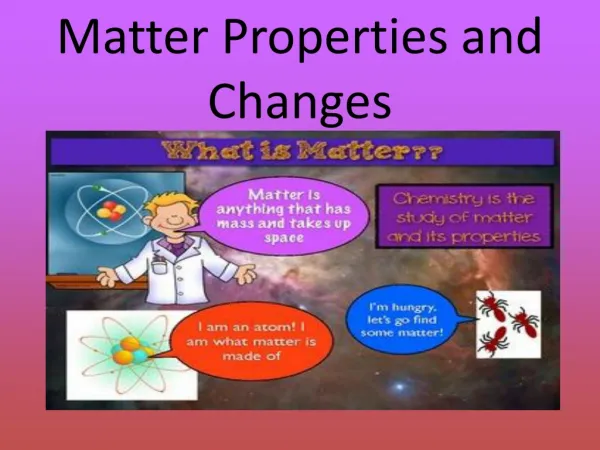
Matter- anything that has mass and takes up space • Physical Change- physical properties change, but the identity of the substance does not change
EXAMPLES OF PHYSICAL CHANGES FREEZING WATER MELTING ICE
PhysicalProperty-any characteristic of a material that can be observed or measured without changing the identity of the material
Density-the amount of mass a material has in a given volume (Density=mass/volume) • Melting Point-the temperature at which a solid becomes a liquid
Freezing Point-the temperature at which a liquid becomes a solid • Specific Heat-the amount of heat needed (measured in Joules) to raise the temperature of 1Kg of substance 1 degree Celsius. (J/kg*C) • Solubility- tells you how much of a solute will dissolve at a given temperature
States of matter- there are four states of matter: solid, liquid, gas, and plasma; the state of matter depends on its temperature and pressure
Chemical Change- a change in the identity of a substance due to the chemical properties of that substance (Is it reversible?)
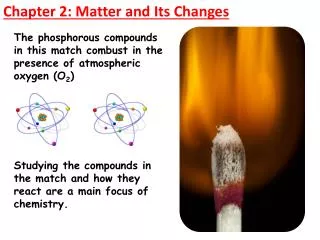
EXAMPLES OF CHEMICAL CHANGES • RUST • LIGHTING A MATCH
Chemical Property- any characteristic that gives a substance the ability to undergo a change that results in a new substance
Law of conservation of mass- the mass of what you end with is always the same as the mass of what you start with