Understanding the Volume of Rectangular Prisms: Concepts and Calculations
This resource explains the volume of rectangular prisms, introducing essential vocabulary and calculation methods. The volume is defined as the amount of cubic units needed to fill a three-dimensional figure. It covers two main approaches to calculating volume: counting cubes in layered figures and using the formula V = L x W x H. An example demonstrates how to calculate the volume of a prism with a 4 cm by 3 cm base and a height of 12 cm, resulting in a total volume of 144 cm³.


Understanding the Volume of Rectangular Prisms: Concepts and Calculations
E N D
Presentation Transcript
Vocabulary • The volume of a three-dimensional figure is the number of cubic units needed to fill the space inside the figure. • A cubic unit is a cube that measures 1 unit long, 1 unit wide, and 1 unit high.
Counting Cubes • If the figure is split into cubes already, then just count the cubes in one layer and multiply that by the number of layers. The top layer is 4 x 5, or 20 cubic units. There are 20 cubic units per layer, times 3 layers, for a volume of 60 cubic units.
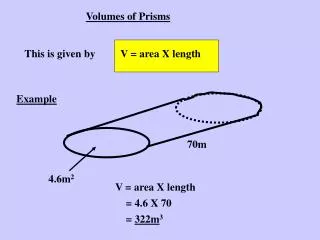
Using Formulas • To find the volume of a rectangular prism, multiply the area of the base by the height. • Volume = Length x Width x Height • V = L x W x H
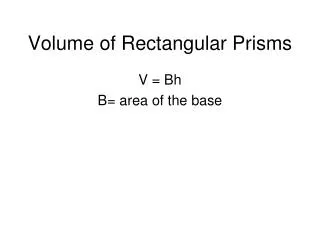
Volume of a Rectangular Prism V = Bh In this case, the base is a rectangle. The area formula for a rectangle is l x w. V = (l x w) x h V = (4 x 3) x 12 V = 144 cm3 Volume gives us cubic units.