Exploring Stack and Heap Structures in Java Programming
This article delves into the intricacies of stack and heap memory management in Java, explaining how data is stored, allocated, and accessed during program execution. It highlights various objects, such as strings and custom classes like `Cat`, illustrating their memory representation and lifecycle. Additionally, it discusses the importance of understanding these concepts for effective debugging, optimization, and memory handling in Java applications. Gain insights into various memory-related operations and learn best practices for managing your Java applications more efficiently.

Exploring Stack and Heap Structures in Java Programming
E N D
Presentation Transcript
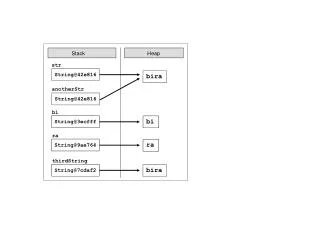
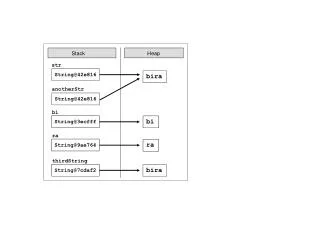
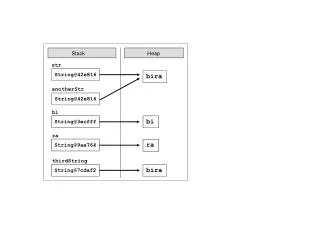
Stack Heap str bira String@42e816 anotherStr String@42e816 bi bi String@3ecfff ra ra String@9ae764 thirdString bira String@7cdaf2
Stack Heap source Some source string@42e816 assigned string@42e816
Stack Heap str1 Hello String@6e278a str2 String@6e278a
Stack Heap greet Hello, String@6e278a name reader! String@2fa8fc result Hello, reader! String@a7b46e
Stack Heap str1 Hello String@6e278a str2 Hello String@821a48
Stack Heap str 0 1 2 3 4 5 6 7 8 910 11 12 13 14 15 16 17 18 20 21 22 23 String@821a48
Stack Heap someCat (Cat members) Cat@6e278a
Stack Heap name: String@a272e8 someCat Cat@6e278a color: String@852fa4 Johny brown
Stack Heap name: String@a272e8 someCat Cat@6e278a color: String@852fa4 Johny brown
Stack Heap i 42 (4 bytes) ch A (2 bytes) result true (1 byte) obj Integer (4 bytes) 42 Integer@9ae764 str Hello String String@7cdaf2 bytes 1 2 3 [B@190d11 byte[]
Stack Heap i 0 (4 bytes) ch B (2 bytes) result Bye false (1 byte) String obj Integer (4 bytes) 42 null str Hello String String@9a787b bytes 1 0 3 [B@190d11 byte[]